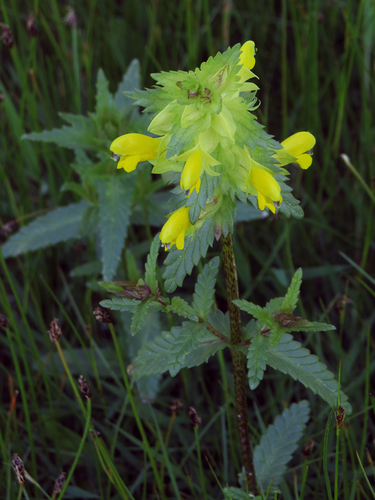
Greater Yellow-rattle
Rhinanthus serotinus
The 'Meadow Maker' of the plant world, Greater Yellow-rattle is a fascinating hemi-parasite that boosts backyard biodiversity. Known for its charming yellow hoods and musical seed pods, it is the secret ingredient for any thriving wildflower patch.
Quick Identification
Size
Height ranges from 20–60 cm (8–24 inches) tall
Colors
Bright yellow tubular flowers often featuring a violet or purple 'tooth' on the upper lip; green to purplish stems with dark spots
Key Features
- Two-lipped yellow flowers with a hooded upper petal
- Opposite, serrated lance-shaped leaves
- Papery, rounded seed capsules that rattle when shaken
- Upright, square-shaped stems often marked with blackish streaks
When You’ll See Them
Behavior
The Greater Yellow-rattle is often called the 'Meadow Maker' due to its unique hemi-parasitic nature. While it can produce its own energy through photosynthesis, it actively seeks out the roots of nearby grasses and legumes, tapping into them to steal water and nutrients. This behavior suppresses the growth of aggressive grasses, which prevents them from outcompeting more delicate wildflower species, resulting in a much more biodiverse environment.
As an annual plant, its entire life cycle—from germination to seed dispersal—occurs within a single growing season. It relies heavily on the wind and movement to disperse its seeds. When the seed pods dry out in late summer, they become thin and papery, encasing loose seeds that create a distinct 'rattling' sound when the wind blows or an animal brushes past, signaling to farmers that it is time to mow the meadow.
EverydayEarth exclusive
Camera Tips
Capturing the Greater Yellow-rattle on a trail camera requires a shift from motion-triggering to time-lapse mode. Because plants don't move enough to trigger standard PIR sensors, set your camera to take a photo every 15 to 30 minutes during daylight hours. This will allow you to create a stunning time-lapse of the flowers opening or the transition from the bright yellow bloom to the dry, papery rattle stage. Position the camera on a short stake about 12 inches off the ground to get a 'bug's eye view' of the flowers.
If you are using an AI-powered camera to capture visiting wildlife, place the camera very close (within its minimum focal distance) to a healthy cluster of Greater Yellow-rattle. These plants are magnets for bumblebees and butterflies. To get the best results, orient the camera facing North or South to avoid the harsh backlighting of the rising or setting sun, which can wash out the vibrant yellow of the petals.
For those interested in the 'rattle' aspect, consider using a camera with a high-quality microphone. In late July or August, a video trigger can capture the swaying of the dry pods in the wind. Ensure your camera is secured to a sturdy post rather than a flexible branch to prevent false triggers from the wind, allowing the movement of the plant itself to be the star of the footage.
Lastly, pay attention to the background. Greater Yellow-rattle stands out best against a backdrop of darker green foliage. If your backyard meadow is overgrown, gently clear a small patch of tall grass behind the flowers to create a natural bokeh effect, making the yellow blooms pop in your digital gallery.
Similar Species
Species that look similar or are commonly confused with Greater Yellow-rattle.
Frequently Asked Questions
Record Greater Yellow-rattle at your habitat
Connect a camera to start building your own species record — AI identifies every visitor automatically.