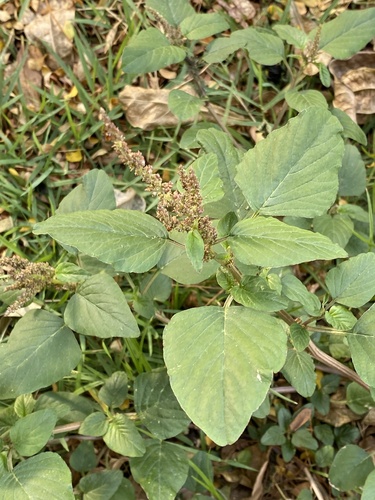
green amaranth
Amaranthus viridis
Often overlooked as a common garden weed, Green Amaranth is a master of survival and a nutritional powerhouse. Its slender green spikes and heart-shaped leaves tell a story of resilience in the sunniest corners of your backyard.
Quick Identification
Size
Typically 10-80 cm (4-31 inches) in height; leaves are 2-7 cm (0.8-2.7 inches) long
Colors
Bright green to pale green foliage; stems may occasionally have a reddish or purplish tint at the base; flower spikes are a dull yellowish-green
Key Features
- Slender, erect green stems
- Terminal flower spikes with smaller clusters in leaf axils
- Ovate to rhombic-ovate leaves with long petioles
- Smooth, hairless stems and leaves
- Produces tiny, black, lens-shaped seeds
When You’ll See Them
Behavior
Green amaranth is a prolific annual herb known for its incredible resilience and rapid growth. While many gardeners categorize it as a weed, it is a pioneer species that excels at colonizing disturbed soil. It uses a specialized form of photosynthesis known as C4 carbon fixation, which allows it to thrive in high temperatures and drought conditions where other backyard plants might wilt. It is a solitary grower but often appears in dense patches due to its high seed production.
Interactions with humans are varied; in many parts of the world, it is a highly valued edible leafy green, harvested when young and tender. However, in suburban North America, it is often seen as a competitor to lawns and ornamental gardens. For wildlife, it provides a vital service, as its dense foliage offers cover for ground-dwelling insects and its protein-rich seeds are a favorite for various songbird species during the late summer months.
EverydayEarth exclusive
Camera Tips
To capture the best images of green amaranth with an AI-powered camera, placement is everything. Since this is a low-growing plant initially, set your camera on a ground stake or a low tripod only 12 to 18 inches off the ground. This 'worm’s-eye view' highlights the structural beauty of the flower spikes and the texture of the leaves, which can look surprisingly architectural when framed against a clear sky or a soft-focus garden background.
If you are using a camera with motion-trigger capabilities, don't expect the plant itself to trigger the sensor unless there is a stiff breeze. Instead, set your camera to time-lapse mode. A photo taken every 30 minutes during daylight hours over the course of a week will reveal the plant's surprisingly aggressive growth and how it angles its leaves to follow the sun. This is our favorite way to document the 'behavior' of backyard flora.
For high-quality identification photos, lighting is your best friend. The morning 'golden hour' (shortly after sunrise) provides a soft, directional light that brings out the veins in the leaves and the granular texture of the seed heads without the harsh shadows of midday. If your camera allows for macro settings, focus on the terminal spikes; the tiny, greenish flowers are fascinatingly complex when viewed up close.
Keep an eye on your camera's background. Green amaranth is—unsurprisingly—very green. To make the plant pop in your photos, try to position the camera so that the plant is framed against a contrasting background, like a dark wooden fence, a brick wall, or a patch of brown mulch. This helps the AI identification software differentiate the plant's silhouette from the surrounding lawn or foliage.
Similar Species
Species that look similar or are commonly confused with green amaranth.
Frequently Asked Questions
Record green amaranth at your habitat
Connect a camera to start building your own species record — AI identifies every visitor automatically.