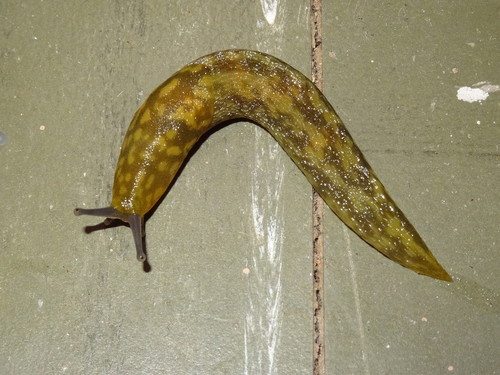
Green Cellar Slug
Limacus maculatus
A nocturnal wanderer with a penchant for damp stone and hidden corners, the Green Cellar Slug is a master of the midnight garden. With its distinctive mottled pattern and steel-blue tentacles, this gentle scavenger is one of the most common yet overlooked residents of the suburban landscape.
Quick Identification
Size
7–13 cm (2.8–5.1 inches) in length
Colors
Dull greenish-yellow base color with dark grey or black mottled blotches; bluish-grey or steel-blue tentacles
Key Features
- Greenish-yellow body with dark irregular mottling
- Long and slender body shape when fully extended
- Tentacles are a distinct bluish-grey color
- Lacks a prominent keel (ridge) along the back
When You’ll See Them
Behavior
The Green Cellar Slug is a predominantly nocturnal creature that emerges from damp crevices once the sun sets. Unlike many of its more destructive garden relatives, this species is largely synanthropic, meaning it has evolved to live closely alongside humans. You will frequently find them scaling damp brick walls, navigating basement entryways, or exploring the perimeter of compost bins. They are surprisingly mobile, often using their keen sense of smell to locate food sources from several meters away.
Socially, they are often found in loose aggregations where moisture and food are abundant. They leave behind a thick, persistent slime trail that not only helps them move across rough surfaces but also serves as a chemical map for other slugs to follow. Interestingly, they are less of a threat to living plants than other species, as they prefer to spend their time cleaning up decaying organic matter or grazing on the micro-flora that grows on damp surfaces.
EverydayEarth exclusive
Camera Tips
To capture the Green Cellar Slug on camera, you need to think low. These mollusks stay close to the ground or climb vertical surfaces, so mount your camera just a few inches off the deck or use a ground-stake mount. Because they are relatively small, check if your camera has a 'Macro' mode or a focus adjustment that allows for clear images at close range. Positioning the camera near a known 'slime highway'—a path on a wall or patio where you see dried silver trails—is the best way to ensure a nightly visitor.
Lighting is your biggest challenge because slug skin is highly reflective. Standard white LEDs can create a 'blown-out' white blob in your photos due to the moisture on their bodies. If possible, use infrared (IR) settings or a camera with a 'No-Glow' flash to capture their natural mottling without the glare. If you are using a standard camera, try to angle it so the flash doesn't hit the slug directly head-on; a side-angle view often reveals the texture and color of the mantle much better than a direct shot.
If you want to guarantee an appearance, you can create a 'lure station.' Place a flat, damp piece of untreated wood or a terracotta pot shard on the ground near a damp wall. Underneath, place a small slice of cucumber or a tiny amount of soaked dry cat food. The Green Cellar Slug has an excellent sense of smell and will often spend an hour or more at a single food source, giving your camera plenty of time to trigger and capture multiple high-quality frames.
Environmental timing is everything with this species. They are most active on humid nights or immediately following a light rain shower. If the weather has been dry, your camera might see zero activity. Try lightly misting the area around your camera setup with a garden sprayer an hour before dusk to simulate the damp conditions they love. This trick often coaxes them out of their hiding spots much earlier in the evening than usual.
Similar Species
Species that look similar or are commonly confused with Green Cellar Slug.
Frequently Asked Questions
Record Green Cellar Slug at your habitat
Connect a camera to start building your own species record — AI identifies every visitor automatically.