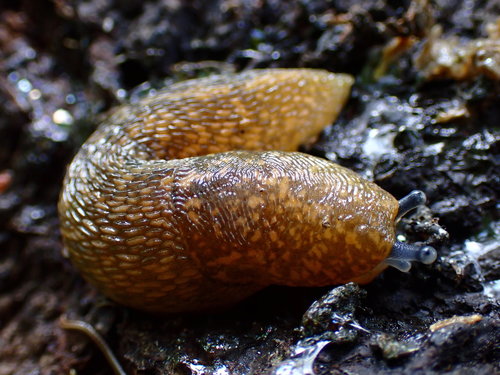
Yellow Cellar Slug
Limacus flavus
The Yellow Cellar Slug is a fascinating, yellow-mottled scavenger that thrives in the damp shadows of our backyards. A master of the night, this gentle invertebrate plays a vital role in breaking down organic matter and keeping garden ecosystems clean.
Quick Identification
Size
7-10 cm (2.8-4 inches) in length, though can reach up to 13 cm (5 inches) when fully extended.
Colors
Pale yellow or greenish-yellow base with mottled greyish-brown spots; tentacles are typically a soft bluish-grey.
Key Features
- Distinctive greenish-yellow mottled body
- Soft blue-grey sensory tentacles
- Produces a characteristic yellow-colored mucus
- Large mantle covering the front third of the body
When You’ll See Them
Behavior
While they are generally solitary as they forage, they are known to have a keen sense of smell, which often leads multiple individuals to the same food source. They move with a slow, rhythmic undulation of their muscular foot, leaving behind a persistent trail of shimmering, slightly yellow-tinted slime. They are not aggressive and pose no threat to humans, though their presence in large numbers usually indicates a very damp environment nearby.
EverydayEarth exclusive
Camera Tips
To successfully capture the Yellow Cellar Slug on your backyard camera, you must focus on the 'micro-habitat.' These creatures stay low to the ground, so your camera should be mounted no more than 3 to 5 inches off the surface. Angle the lens downward toward a flat, damp area. If your camera has a close-focus or macro setting, this is the time to use it, as it will allow you to capture the fascinating texture of their skin and the movement of their rhythmic breathing pore (pneumostome).
Baiting is the most effective way to ensure a sighting. Place a small, shallow dish of beer or a tablespoon of wet cat food directly in the camera's field of view. The strong scent of fermentation or protein will draw them out from their hiding spots. Since slugs move significantly slower than mammals or birds, set your camera to record longer video clips—at least 30 seconds—or use a high-frequency time-lapse mode. A standard 5-second burst will likely only show a slight change in position, whereas a longer clip reveals their graceful, liquid-like movement.
Night vision is essential for this species. While 'Glow' IR cameras are fine because slugs aren't startled by the red LEDs, a 'No-Glow' camera is better if you want to see how other backyard wildlife interacts with the slug. Look for damp nights or set your camera up immediately after a rainstorm. In dry weather, you can 'create' activity by heavily watering a small patch of ground near a woodpile or stone wall a few hours before sunset, making it the most attractive spot in the neighborhood for a thirsty slug.
Similar Species
Species that look similar or are commonly confused with Yellow Cellar Slug.
Frequently Asked Questions
Record Yellow Cellar Slug at your habitat
Connect a camera to start building your own species record — AI identifies every visitor automatically.