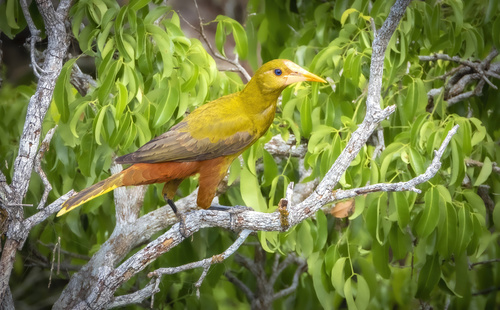
Green Oropendola
Psarocolius viridis
With its shimmering olive plumage and unmistakable orange-tipped bill, the Green Oropendola is a master of the Amazonian canopy. Famous for their intricate hanging nests and liquid, gurgling calls, these social birds bring a vibrant energy to the South American rainforest.
Quick Identification
Size
Length 35-47 cm (14-18.5 in); weight 200-400g (7-14 oz)
Colors
Mainly olive-green plumage; pale ivory bill with a distinct orange tip; bright yellow outer tail feathers; pale blue eyes.
Key Features
- Pale ivory bill with a bright orange tip
- Olive-green body plumage
- Bright yellow outer tail feathers
- Striking pale blue eyes
- Large, hanging basket-like nests
When You’ll See Them
Geographic range
Where Does the Green Oropendola Live?
Deep within the lush landscapes of South America, the Green Oropendola claims the vast Amazon basin and the Guiana Shield as its home. This vibrant bird is a resident across several countries, with core populations thriving in Brazil, Colombia, Peru, and Venezuela, as well as the coastal regions of Guyana, Suriname, and French Guiana. Unlike some migratory species, these birds are year-round fixtures of the tropical canopy, where they favor humid lowland forests and the sun-drenched edges of river clearings.
Basemap © OpenStreetMap contributors
Behavior
The Green Oropendola is a highly social bird known for its remarkable colonial nesting habits. They live in groups where a dominant male typically oversees a harem of females. Their most famous behavior is the construction of pendulous, bag-like nests that can hang over 3 feet long from the tips of high tree branches. These colonies are often built away from the main trunk to protect eggs and chicks from climbing predators like snakes and monkeys.
Vocalization is a massive part of their social structure. Males perform elaborate displays, bowing deeply until they are almost upside down while emitting a series of liquid, gurgling, and crashing sounds that are synonymous with the Amazonian dawn. While they are primarily canopy dwellers, they are bold and curious, often moving through the middle layers of the forest in noisy, active flocks.
EverydayEarth exclusive
Camera Tips
To capture the Green Oropendola on camera, height is your best friend. Since these birds spend the vast majority of their time in the canopy, a ground-level camera will likely only catch them if they drop down for water or fallen fruit. If you have a backyard bordering a tropical forest, try mounting your camera on a high balcony or using a pulley system to hoist it 10-15 feet up into a fruiting tree like a Cecropia or a Ficus.
Baiting is highly effective for this species. They are particularly fond of overripe bananas, papayas, and plantains. To get the best shots, secure the fruit to a sturdy branch within the camera's focal range (usually 3-5 feet). Because they travel in social groups, once one bird finds your 'buffet,' others will likely follow, giving you plenty of opportunities for multi-subject photos and videos.
Regarding camera settings, the Green Oropendola is a fast mover, especially during its dramatic bowing displays. Use a high shutter speed if your camera allows manual overrides, or set your AI camera to 'Sports' or 'Action' mode. If you are monitoring a nesting colony, time-lapse mode is a fantastic way to capture the architectural progress of their hanging nests over several weeks. Early morning light provides the best illumination for their olive-green feathers, so ensure your camera is positioned to avoid direct lens flare from the rising sun.
Similar Species
Species that look similar or are commonly confused with Green Oropendola.
Crested Oropendola
The Crested Oropendola has a red-tipped bill and much darker, nearly black plumage compared to the Green's olive body.
Olive Oropendola
The Olive Oropendola is much larger and lacks the distinct orange tip on the bill, usually having a darker, more uniform bill color.
Russet-backed Oropendola
Features a darker, chestnut-colored back and a bill that is typically dark at the base, unlike the pale bill of the Green Oropendola.
Frequently Asked Questions
Record Green Oropendola at your habitat
Connect a camera to start building your own species record — AI identifies every visitor automatically.