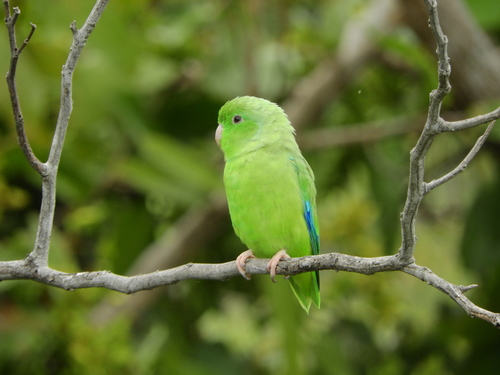
Green-rumped Parrotlet
Forpus passerinus
Meet the Green-rumped Parrotlet, the smallest parrot in the Americas. These pint-sized socialites bring a flash of emerald and cobalt to backyards from the Amazon to the Caribbean.
Quick Identification
Size
Length: 12-13 cm (4.7-5.1 inches); Wingspan: 20-24 cm (8-9.5 inches); Weight: 20-28 grams (0.7-1.0 ounces)
Colors
Primary emerald green plumage. Males have striking cobalt-blue on the underwing and lower back; females lack blue and have more yellow on the forehead.
Key Features
- Tiny, sparrow-sized parrot body
- Short, wedge-shaped tail
- Males feature brilliant blue wing accents
- Large, pale-colored hooked beak for its size
When You’ll See Them
Geographic range
Where Does the Green-rumped Parrotlet Live?
Native to the northern regions of South America, the Green-rumped Parrotlet thrives across Venezuela, Colombia, Guyana, Suriname, and the lower Amazon basin in Brazil. It is a highly successful colonizer and has established healthy introduced populations across several Caribbean islands, including Jamaica, Barbados, and Curaçao. Within its range, it is a lowland specialist, rarely venturing into high-altitude mountain ranges, preferring the warm, humid air of the coasts and river basins.
Basemap © OpenStreetMap contributors
Behavior
Green-rumped Parrotlets are intensely social birds that are almost always found in small, chattering flocks of 5 to 20 individuals. They are highly communicative, maintaining constant contact with high-pitched chirps and whistles that can be heard long before the birds are seen. In flight, they move with a swift, slightly undulating pattern, often landing abruptly in the canopy where their green feathers provide near-perfect camouflage.
These parrots are unique for their nesting habits, often using hollowed-out tree cavities, fence posts, or even abandoned nests of other species like the Rufous-fronted Thornbird. Unlike many other parrots, they are relatively bold around human settlements, often frequenting city parks and backyard gardens where food is plentiful. They spend a significant portion of their day foraging, showing a particular fondness for grass seeds found on the ground or in low-lying shrubbery.
EverydayEarth exclusive
Camera Tips
To capture these tiny parrots on camera, focus your efforts on water sources. Green-rumped Parrotlets need to drink frequently, especially in warmer climates. A shallow, elevated birdbath placed near native fruiting trees is your best bet. Position your camera about 3 to 5 feet away from the water source to ensure the motion sensor triggers quickly enough to catch their rapid movements. Because they are so small, using a camera with a high-resolution sensor (4K preferred) will allow you to crop the image later without losing the detail of their feathers.
Since these birds often forage for grass seeds, a ground-level camera set near a patch of seeding tall grass can yield spectacular close-up footage. Place the camera on a low tripod or a weatherproof mount just a few inches off the ground. If you are using bait, birdseed mixes containing small millet or sunflower hearts can attract them, though they are often more interested in natural seeding grasses. Set your camera's burst mode to take 3-5 photos per trigger to account for their constant, jerky movements while feeding.
Lighting is crucial for bringing out the iridescent greens and blues of their plumage. Try to angle your camera so the sun is behind it during the early morning hours. This 'front-lighting' will illuminate the male’s cobalt-blue wing patches, which can otherwise look dark or black in shadow. If your camera has a 'high sensitivity' or 'fast shutter' setting, enable it; these birds rarely sit still for more than a few seconds, and you'll want to avoid motion blur during their frequent social squabbles.
Similar Species
Species that look similar or are commonly confused with Green-rumped Parrotlet.
Frequently Asked Questions
Record Green-rumped Parrotlet at your habitat
Connect a camera to start building your own species record — AI identifies every visitor automatically.