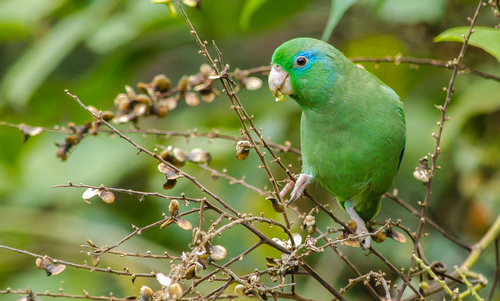
Spectacled Parrotlet
Forpus conspicillatus
The Spectacled Parrotlet is a pint-sized powerhouse of color and personality, famous for the brilliant blue 'glasses' that give the species its name. A common sight in Colombian backyards, these social birds bring life and chatter to any garden.
Quick Identification
Size
12-13 cm (4.7-5.1 inches) in length; 25-30 grams (0.9-1.1 ounces)
Colors
Bright lime-green body; males have violet-blue markings around eyes, wings, and lower back; females are entirely green with emerald eye-rings.
Key Features
- Distinctive blue 'spectacle' rings around eyes in males
- Extremely short, wedge-shaped tail
- Small, stocky budgie-like build
- Pale horn-colored beak
When You’ll See Them
Geographic range
Where Does the Spectacled Parrotlet Live?
The Spectacled Parrotlet is a native resident of South America and the southern reaches of Central America. Its core range spans the lush valleys and lowlands of Colombia, extending westward into eastern Panama and eastward into western Venezuela. These birds thrive in tropical and subtropical zones, often following the corridors created by river valleys and agricultural developments where food sources are abundant.
Basemap © OpenStreetMap contributors
Behavior
Spectacled Parrotlets are highly social and energetic birds that usually travel in pairs or small family groups. They communicate with a constant stream of high-pitched chirps and metallic 'tseet' calls, which they use to maintain contact while foraging in dense foliage. They are known for their deep pair bonds, often seen perched close together and engaged in mutual preening to reinforce their social ties.
Unlike many parrots that stay high in the canopy, Spectacled Parrotlets are comfortable descending to lower shrubs or even the ground to feed on grass seeds. They are well-adapted to human environments and are frequently seen in suburban gardens, cattle pastures, and city parks. Despite their small size, they are quite bold and can be surprisingly territorial near their nesting sites, which are typically hollowed-out tree cavities or even man-made structures.
EverydayEarth exclusive
Camera Tips
To capture high-quality footage of Spectacled Parrotlets, place your camera near low-lying water sources or birdbaths. These birds are frequent drinkers and bathers, especially during the hotter parts of the day. Setting your camera at a height of 3 to 4 feet, focused on a flat stone or a shallow pool, will provide the best angle for these diminutive birds. Because they are so small and move rapidly, use a fast shutter speed or high-frame-rate video setting to avoid motion blur.
If you are baiting an area for a backyard camera, use small-seed mixes (similar to finch or budgie food) or offer fruit like fresh papaya or guava. Place the feeder in a spot that receives bright, indirect sunlight; the vibrant green and blue plumage of the Spectacled Parrotlet pops best in soft morning light. Avoid placing the camera in deep shade, as their green feathers can easily blend into the background leaves, making it hard for AI triggers to identify them.
These parrots are gregarious, so if you catch one on camera, expect to see its mate or family group shortly after. Set your camera's 'detection delay' to the minimum setting so you can capture the social interactions between pairs. Because they nest in cavities, you can also try mounting a camera near a wooden fence post or a nesting box with a small entrance hole during the breeding season (typically January through August).
Similar Species
Species that look similar or are commonly confused with Spectacled Parrotlet.
Frequently Asked Questions
Record Spectacled Parrotlet at your habitat
Connect a camera to start building your own species record — AI identifies every visitor automatically.