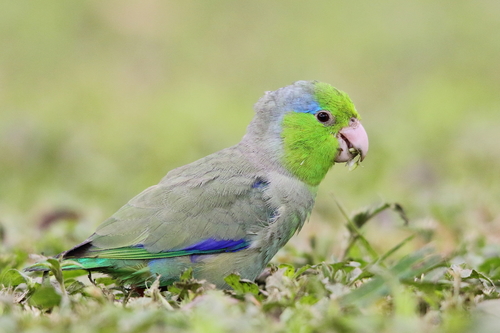
Pacific Parrotlet
Forpus coelestis
Often called 'Pocket Parrots,' the Pacific Parrotlet is a tiny bundle of energy with a personality far larger than its four-inch frame. Found darting through the dry forests of Ecuador and Peru, these social birds are a delight for backyard observers and wildlife photographers alike.
Quick Identification
Size
12–14 cm (4.7–5.5 inches) long; wingspan approx. 20–25 cm (8–10 inches); weight 24–30 grams (0.8–1.1 oz).
Colors
Predominantly olive-green with a greyish wash. Males feature vibrant cobalt blue on the primary coverts, secondaries, and lower back/rump; females are mostly green with pale yellow on the face.
Key Features
- Tiny, stocky build with a short, wedge-shaped tail
- Males display distinct cobalt blue patches on wings and rump
- Large, pale-colored beak relative to its diminutive body size
- Constant chattering and rapid, darting flight pattern
When You’ll See Them
Geographic range
Where Does the Pacific Parrotlet Live?
The Pacific Parrotlet is native to the western regions of South America, primarily inhabiting the Pacific slopes of the Andes. Their core territory stretches from western Ecuador down through northwestern Peru, where they thrive in the arid coastal plains and foothills. While their native range is focused in these equatorial regions, small introduced populations have occasionally been established in tropical locales like Puerto Rico.
Basemap © OpenStreetMap contributors
Behavior
Pacific Parrotlets are high-energy socialites of the bird world, often seen in small flocks of 10 to 40 individuals. Despite their diminutive "pocket parrot" size, they possess bold, feisty personalities and are known for their intelligence and curiosity. In the wild, they spend much of their day foraging on the ground or in low-lying shrubs, maintaining constant vocal contact with their mates through soft chirps and chattering.
They are monogamous birds that form deep pair bonds, often seen preening one another or perched closely together on branches. While they are generally wary of humans in the wild, they have adapted well to modified landscapes like orchards and suburban gardens. Their social structure is complex, and they can be quite territorial during the nesting season, defending small cavities in trees or fence posts with surprising tenacity.
EverydayEarth exclusive
Camera Tips
Capturing the Pacific Parrotlet on camera requires a strategy focused on their low-altitude lifestyle. Unlike many parrots that stay in the canopy, these birds often forage near the ground or on low shrubs. Place your camera 3 to 5 feet off the ground, angled slightly downward toward a known water source or a flat area where grass seeds are abundant. Because they are small and fast, a high-speed trigger and a "burst mode" setting are essential to avoid getting nothing but a green blur.
In a backyard setting, parrotlets are highly attracted to shallow birdbaths and feeding stations offering small millet or sunflower seeds. Position your camera near these hotspots, ideally facing north or south to avoid lens flare during the peak activity hours of early morning and late afternoon. If you are using an AI-powered camera, ensure the sensitivity is set to high; their small size might not always trigger sensors designed for larger mammals.
Natural light is your best friend for capturing their vibrant colors. Try to place your setup in an area that receives bright, filtered sunlight. During the breeding season (early in the year), keep an eye out for pairs investigating hollows in fence posts or trees. Mounting a camera near these potential nesting sites can provide intimate glimpses of their social grooming behaviors, but be sure to keep a respectful distance to avoid disturbing the pair.
Similar Species
Species that look similar or are commonly confused with Pacific Parrotlet.
Frequently Asked Questions
Record Pacific Parrotlet at your habitat
Connect a camera to start building your own species record — AI identifies every visitor automatically.