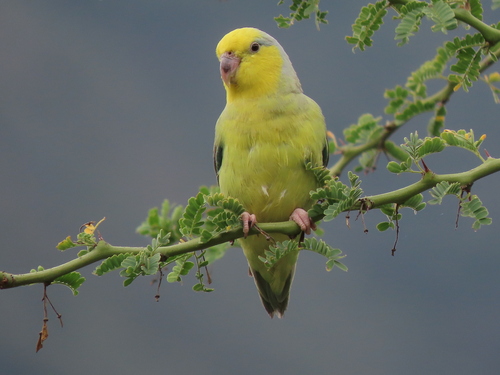
Yellow-faced Parrotlet
Forpus xanthops
Endemic to the hidden valleys of Peru, the Yellow-faced Parrotlet is a vibrant splash of gold and blue in the arid scrub. Rare and social, this small parrot is a masterpiece of South American evolution.
Quick Identification
Size
14.5 cm (5.7 in) in length; weight ranges from 30 to 35 grams (1.1 to 1.2 oz)
Colors
Bright yellow forehead, crown, and face; olive-green body; males have deep violet-blue rumps and wing patches, while females have lighter blue markings.
Key Features
- Vivid yellow face and throat
- Deep blue lower back and rump
- Greyish-brown bill with a pale base
- Small, stocky build with a short, wedge-shaped tail
When You’ll See Them
Geographic range
Where Does the Yellow-faced Parrotlet Live?
The Yellow-faced Parrotlet is a South American treasure with a very restricted geographic footprint. It is endemic to north-central Peru, where it is found exclusively in the upper Marañón River valley and its associated drainage systems. This species thrives in the unique rain-shadow microclimates of the Andes, staying within these dry, isolated valleys rather than venturing into the surrounding humid rainforests.
Basemap © OpenStreetMap contributors
Behavior
Yellow-faced Parrotlets are remarkably social and energetic birds that spend much of their lives in tight-knit flocks, often consisting of 10 to 30 individuals. While they can be quite vocal during flight, emitting high-pitched chirps to maintain contact with the group, they become surprisingly quiet and cryptic once they land in the canopy or scrub, blending perfectly with the foliage. They are known for their fast, direct flight and agile climbing abilities while foraging.
In their natural environment, these birds exhibit a strong pair-bonding system, with mated pairs often seen sitting close together and preening one another. Their interactions with humans are generally cautious; they are shy birds that prefer the cover of arid thickets. However, they are highly motivated by water sources in their dry habitat, making them predictable visitors to specific watering holes during the heat of the day.
EverydayEarth exclusive
Camera Tips
To successfully capture the Yellow-faced Parrotlet on camera, you must focus on their most critical resource: water. Because they inhabit arid regions, setting up a camera near a consistent water source or a shallow birdbath is highly effective. Place your camera at a low angle, roughly 1 to 2 feet above the ground, to capture them as they land to drink. Ensure the lens is positioned to avoid the harsh glare of the midday sun, which can wash out their bright yellow plumage.
Morning is the prime time for photography. Set your camera's trigger interval to the shortest possible setting, as these birds move quickly and often arrive in groups; a single bird landing usually signals that a dozen more are right behind it. If you are using a trail camera, high-speed video mode (60fps or higher) is recommended to capture their rapid wing beats and social interactions. Avoid using white-light flashes, which will likely flush the entire flock; stick to natural light or high-quality 'no-glow' infrared for early dawn activity.
Since these birds are endemic to specific Peruvian valleys, habitat-specific placement is key. Look for fruiting cacti or seeding grasses. If your camera allows for zone-based triggering, focus on the perches just above the food source where they often land to survey the area before feeding. Using a telephoto lens or a camera with a narrow field of view can help isolate these small birds against the busy, thorny background of their scrubland home.
Similar Species
Species that look similar or are commonly confused with Yellow-faced Parrotlet.
Frequently Asked Questions
Record Yellow-faced Parrotlet at your habitat
Connect a camera to start building your own species record — AI identifies every visitor automatically.