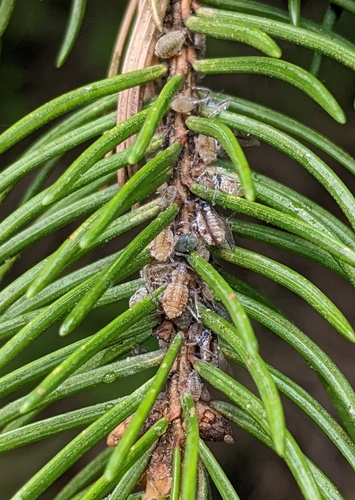
Green-striped Spruce Aphid
Cinara piceicola
Hidden among the needles of your backyard spruce lies a bustling metropolis of Green-striped Spruce Aphids. These large, striped insects are the centerpiece of a miniature ecosystem, guarded by ants and fueled by the life-blood of the forest.
Quick Identification
Size
Length 3.0-5.0 mm (0.12-0.20 inches)
Colors
Pale to medium green body with two or more dark green or brownish longitudinal stripes; legs and antennae are often a darker, dusky brown.
Key Features
- Large, pear-shaped body compared to common garden aphids
- Distinctive dark green stripes running lengthwise down the abdomen
- Found specifically on the bark of spruce twigs rather than the needles
- Long, robust legs that allow for surprisingly quick movement
When You’ll See Them
Behavior
The Green-striped Spruce Aphid is a social insect that lives in dense colonies. Unlike the tiny aphids found on rose bushes, these are "bark aphids" that prefer the sturdier environment of spruce branches. They use their specialized piercing-sucking mouthparts to penetrate the bark and tap into the tree's phloem, where they drink nutrient-rich sap.
These aphids are famous for their symbiotic relationship with ants. As they feed, they excrete a sugary liquid called honeydew. Ants visit the colonies to harvest this honeydew as a primary food source. In return, the ants act as fierce protectors, driving away predators like ladybugs, lacewings, and parasitic wasps that might otherwise decimate the aphid population.
EverydayEarth exclusive
Camera Tips
To capture high-quality images of the Green-striped Spruce Aphid, you need to think small and get close. Because these insects are only a few millimeters long, a standard trail camera may struggle to focus. For the best results, use a macro lens attachment or a camera with a dedicated "macro" mode that can focus within 2 to 6 inches. Position your camera on a sturdy branch of a spruce tree, specifically looking for areas where the current year's growth meets the older wood, as these transition zones are highly attractive to feeding colonies.
Instead of searching for the aphids directly, look for "ant highways." If you see a steady stream of ants moving up and down a spruce trunk, follow them—they will invariably lead you to an aphid colony. Mounting your camera at this junction will allow you to capture not just the aphids, but the fascinating social interactions between the aphids and their ant shepherds. Use a mounting bracket or a heavy-duty strap to ensure the camera doesn't vibrate in the wind, which can ruin macro shots.
Lighting is the most critical factor for showing the green-on-green stripes. Early morning or late afternoon light provides the best contrast without the harsh glare that can bounce off the aphids' slightly waxy bodies. If your camera has a built-in LED or ring light, use it to fill in the shadows often found deep within spruce boughs. Set your camera to a high-resolution photo mode or a 4K video setting; even at 10 seconds, a video clip will reveal the rhythmic pulsing of the aphids as they feed.
Check your camera every few days during the peak summer months. If you notice a black, sooty substance on the needles below your camera site, that is "sooty mold" growing on excess honeydew. This is a sign that the colony is thriving and you are in the right spot. For a unique shot, try to capture the "alates"—the winged version of the aphids—which typically appear in late spring or late summer as they prepare to fly off and colonize new trees.
Similar Species
Species that look similar or are commonly confused with Green-striped Spruce Aphid.
Frequently Asked Questions
Record Green-striped Spruce Aphid at your habitat
Connect a camera to start building your own species record — AI identifies every visitor automatically.