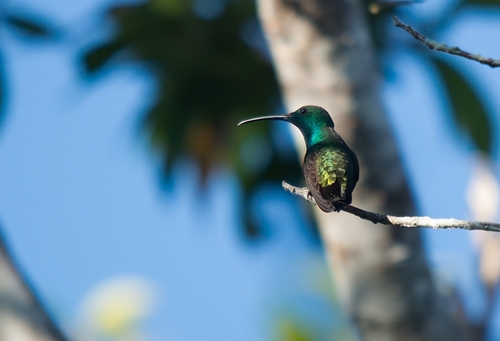
Green-throated Mango
Anthracothorax viridigula
With a shimmering emerald throat and a bold, territorial personality, the Green-throated Mango is a crown jewel of South America's coastal wetlands. This large hummingbird is a master of the mangroves, known for its striking colors and preference for sunny, open gardens.
Quick Identification
Size
11.5–12.5 cm (4.5–4.9 in) long; weight approximately 7.5–9 g (0.26–0.32 oz)
Colors
Iridescent green upperparts; males have a glittering green throat and a black stripe down the center of the belly; females have white underparts with a broad black central stripe.
Key Features
- Large, slightly decurved black bill
- Iridescent green throat (male) or black-on-white underparts (female)
- Deep maroon or purple-toned tail with dark tips
- Stocky build compared to other small hummingbirds
When You’ll See Them
Geographic range
Where Does the Green-throated Mango Live?
This stunning hummingbird is native to the northern and northeastern tropical regions of South America. Its core range encompasses the coastal stretches of Venezuela, the Guianas, and northeastern Brazil, as well as the island of Trinidad. It is almost exclusively a lowland specialist, rarely venturing far from the humid, water-influenced landscapes of the Atlantic coast and the Amazon river mouth.
Basemap © OpenStreetMap contributors
Behavior
The Green-throated Mango is a bold and territorial hummingbird, frequently seen defending its preferred nectar sources from other birds. Unlike many forest-dwelling hummingbirds that remain hidden in the canopy, the Mango prefers semi-open landscapes and is often observed perching prominently on high, bare branches to survey its territory. It is a powerful flyer with a direct, fast flight pattern.
While they are largely solitary, they can be social around high-value food sources like large flowering trees. They exhibit 'trap-lining' behavior, moving in a predictable circuit between various nectar-rich plants throughout the day. Their interactions with humans are generally passive, and they can become quite accustomed to backyard feeders in suburban areas that border their natural wetland habitats.
EverydayEarth exclusive
Camera Tips
To capture the Green-throated Mango on a backyard camera, focus on their preferred vertical height. Unlike ground-dwelling birds, these hummingbirds usually forage between 3 and 10 feet off the ground. Mount your camera on a tripod or post at about 5 feet, aiming it at large-tubular flowers like hibiscus or heliconia. Because they are fast-moving, use a high-speed trigger setting or a camera capable of 60fps video to avoid motion blur during their characteristic hovering.
Lighting is the most important factor for success. The 'green' throat of this species is structural, meaning it only shimmers when light hits it at the correct angle. Position your camera with the sun at your back, facing the flower or feeder. Early morning or late afternoon sun provides the warm, low-angled light necessary to make the male's emerald throat 'pop' against the darker background of his breast stripe.
One of the best tricks for capturing this specific species is to identify their 'sentry perch.' Green-throated Mangos are highly territorial and will return to the same bare twig or wire every few minutes to guard their food. If you see a bird repeatedly landing on the same spot, move your camera to focus specifically on that perch. This allows you to capture high-quality, still images of the bird while it is resting, which is much easier for AI identification than a bird in mid-hover.
If you use a nectar feeder, opt for one with a perch. While Mangos can hover easily, they often prefer to land while drinking, giving your camera more time to lock focus and capture the intricate details of their plumage. Ensure the feeder is in a semi-open area; this species is less likely to visit feeders buried deep in dense shade or thickets.
Similar Species
Species that look similar or are commonly confused with Green-throated Mango.
Black-throated Mango
Very similar, but the Black-throated is typically found in drier, more inland habitats and the male has a much broader, more solid black area on its underparts.
Ruby-topaz Hummingbird
Much smaller with a bright orange-gold throat and a ruby-red crown; lacks the Mango's distinctive black central breast stripe.
Frequently Asked Questions
Record Green-throated Mango at your habitat
Connect a camera to start building your own species record — AI identifies every visitor automatically.