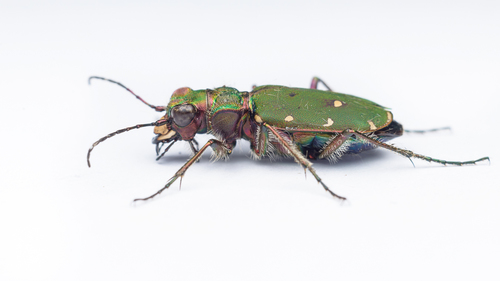
Green Tiger Beetle
Cicindela campestris
Meet the 'cheetah' of your garden path. With its brilliant metallic green armor and incredible sprinting speed, the Green Tiger Beetle is a high-speed predator that turns any sunny patch of dirt into a miniature hunting ground.
Quick Identification
Size
12-15 mm (0.47-0.59 inches) in length
Colors
Brilliant iridescent green body; metallic copper or bronze legs; 5-6 small yellowish-white spots on each wing case (elytra)
Key Features
- Large, bulging black eyes for 360-degree vision
- Long, spindly copper-colored legs built for high-speed running
- Powerful, sickle-shaped mandibles for crushing prey
- Iridescent green body with distinctive cream-colored spots
When You’ll See Them
Behavior
The Green Tiger Beetle is one of nature's most formidable hunters, often referred to as the 'cheetah' of the insect world. They are incredibly agile, capable of running at speeds that would be equivalent to a human running at 200-300 mph. Interestingly, they run so fast that their eyes cannot process light quickly enough to see where they are going, forcing them to stop momentarily to 're-focus' before continuing their high-speed chase.
These beetles are highly sun-dependent, using solar heat to fuel their high-metabolism lifestyle. When they aren't hunting, they are extremely wary of their surroundings. They possess excellent eyesight and will take flight if they sense a shadow or movement nearby, usually landing a few meters away to face the intruder. While they are solitary hunters, you may find several in a small area if the habitat—typically sunny, bare ground—is ideal for their burrowing larvae.
EverydayEarth exclusive
Camera Tips
Capturing the Green Tiger Beetle on camera requires a ground-level strategy. Because these insects are small and stay close to the earth, your camera should be mounted no more than 2 to 5 inches off the ground. If you are using a trail camera, look for 'micro-habitats' like a bare patch of sandy soil or a sunny garden path where they like to bask. Use a macro lens attachment if possible, as these beetles are only about half an inch long; without one, the beetle may appear as a tiny green speck in a wide-angle shot.
Lighting is your best friend and your biggest challenge with this species. They are most active during the brightest parts of the day, which provides excellent natural light for high-speed shutter settings needed to freeze their rapid movement. However, their iridescent bodies are highly reflective. To avoid 'blown-out' highlights on their metallic green shells, try to position your camera so the sun is at a 45-degree angle rather than directly overhead, or use a small diffuser if you are setting up a stationary macro-trap.
While most trail cameras are triggered by heat and motion (PIR sensors), insects like the Green Tiger Beetle often fail to trigger standard sensors due to their small size and cold-blooded nature. The best strategy is to use a camera with a 'Time Lapse' mode or 'High-Frequency Motion Detection.' Set your camera to take a photo every 20-30 seconds in a known 'hot spot' during the peak hours of 11 AM to 3 PM. Look for 'sun traps'—areas protected from the wind that bake in the midday sun.
To increase your chances of a close-up, you can create a 'natural stage' by clearing a small 1-foot square area of vegetation to expose bare earth. Green Tiger Beetles are naturally drawn to these open patches for both hunting and sunbathing. While you don't need food lures, placing a small piece of overripe fruit just outside the frame can attract ants or flies, which will in turn draw the Tiger Beetle in for a hunt, allowing you to capture dramatic predatory action shots.
Similar Species
Species that look similar or are commonly confused with Green Tiger Beetle.
Frequently Asked Questions
Record Green Tiger Beetle at your habitat
Connect a camera to start building your own species record — AI identifies every visitor automatically.