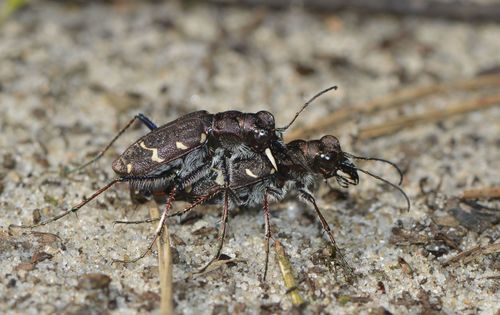
Wood Tiger Beetle
Cicindela sylvatica
Meet the 'cheetah' of the heathland. The Wood Tiger Beetle is a lightning-fast predator that combines a dark, bronzed elegance with fierce hunting prowess, making it a thrilling find for any backyard observer.
Quick Identification
Size
15–19 mm (0.59–0.75 in) in length
Colors
Primary dull black with a subtle blue or violet tinge, creamy white wavy bands on the wing cases (elytra), and a metallic blue underside.
Key Features
- Largest UK tiger beetle (up to 19mm)
- Dull black or dark bronze body with wavy cream-colored markings
- Distinctive metallic blue or violet underside
- Long, spindly legs built for high-speed running
- Large, bulging eyes and powerful, sickle-shaped mandibles
When You’ll See Them
Behavior
During the heat of the day, they are most frequently observed on open, sandy patches of ground where they bask to regulate their body temperature. This high-octane lifestyle requires significant warmth; without direct sunlight, they become sluggish and retreat into burrows. When approached, they are incredibly skittish, taking flight with a characteristic low buzz before landing several meters away, almost always facing the source of the disturbance to keep a watchful eye on potential threats.
EverydayEarth exclusive
Camera Tips
Because these beetles move in sudden, lightning-fast bursts, a standard trail camera may struggle with trigger speed. If your camera has a 'Pro' or 'High-Speed' mode, use it. A high frame rate for video (60fps or higher) is ideal for capturing the moment they take flight or the 'stop-start' rhythm of their hunt. Set your camera to take bursts of 3-5 photos to ensure at least one shot catches them while they are stationary between sprints.
Lighting is your best friend and your worst enemy with this species. They only emerge in direct, bright sunlight, which can cause harsh glares on their dark bodies. Position your camera so the sun is behind the lens or slightly to the side to highlight the cream-colored wavy markings on their backs without washing out the deep black coloration. Avoid placing cameras in areas that will be shaded by trees during the peak hours of 11 AM to 2 PM.
To increase your chances of a close-up, you can create an artificial 'hot spot' by clearing a small 12-inch square of pine needles or leaf litter to reveal the underlying sand. These beetles are naturally drawn to these clearings for hunting and sunbathing. Place your camera at the very edge of this cleared patch. If you are using a smartphone or a manual camera, a remote Bluetooth trigger is highly recommended so you can sit several meters away; your silhouette or movement will easily spook them before you can get the shot.
Similar Species
Species that look similar or are commonly confused with Wood Tiger Beetle.
Frequently Asked Questions
Record Wood Tiger Beetle at your habitat
Connect a camera to start building your own species record — AI identifies every visitor automatically.