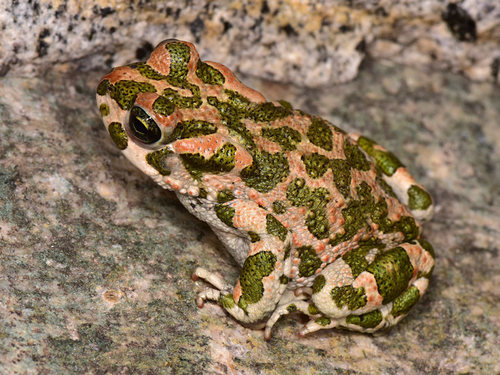
Green Toad
Bufotes viridis
With its striking emerald-patterned skin and a song that sounds more like a bird than a frog, the Green Toad is the jewel of the European garden. This resilient wanderer thrives in the most unlikely places, from city parks to sun-drenched coastal dunes.
Quick Identification
Size
4.8 to 12 cm (1.9 to 4.7 inches) in length; weighing 10 to 45 grams (0.35 to 1.6 ounces)
Colors
Creamy white to light grey base color with distinct, irregular islands of bright green or olive-green. Females often have more vivid, contrasting patterns than males, and some individuals may show small reddish spots.
Key Features
- Distinctive green blotches on a pale background
- Kidney-shaped parotoid glands behind the eyes
- Dry, warty skin typical of true toads
- High-pitched, cricket-like trilling call
When You’ll See Them
Behavior
The Green Toad is a hardy and adaptable amphibian, often referred to as a 'pioneer species' because it is among the first to colonize new or disturbed habitats. Unlike many other amphibians that require damp forests, the Green Toad thrives in open spaces like steppes, urban gardens, and even semi-desert environments. They are particularly resilient to heat and can tolerate more arid conditions than the Common Toad, often hiding under stones or in burrows during the hottest parts of the day.
These toads are primarily terrestrial and move with short, quick hops rather than the long leaps associated with frogs. During the breeding season, which typically occurs after spring rains, males gather at shallow, sun-warmed water sources to perform their melodic, bird-like trilling calls. Outside of breeding, they are relatively solitary and can be found quite far from water, patrolling gardens and parks for prey.
EverydayEarth exclusive
Camera Tips
To capture the elusive Green Toad on camera, placement is everything. Since these toads are strictly ground-dwellers, you must position your camera just a few inches off the ground. Avoid pointing the camera straight down; instead, angle it slightly upward or place it horizontally along a known travel path, such as the edge of a garden wall or a patio. Using a small tripod or a specialized ground stake will help stabilize the shot and ensure you aren't just filming the tops of their heads.
One of the best 'hacks' for attracting Green Toads to your camera's field of view is to utilize light. While the toads are nocturnal, their prey—nocturnal insects—are attracted to light sources. Placing your camera near a low-voltage garden light or even a porch light can create a buffet that will keep a toad in front of the lens for several minutes. Alternatively, placing a shallow dish of water in an open area during a dry spell will act as a powerful magnet, as they will visit frequently to rehydrate through their skin.
Because toads move in short, sudden bursts, you should adjust your camera's PIR (Passive Infrared) sensitivity to 'High.' If your camera supports it, use a 'Photo + Video' mode. The initial photo will capture the toad as it enters the frame, while the subsequent video will record its unique walking gait or hunting behavior. If you are aiming to record their distinct cricket-like call, ensure your camera's microphone is unobstructed and set to high gain during the spring breeding months.
Lastly, pay attention to the background. Green Toads have remarkable camouflage. To make them 'pop' on camera, try to frame your shot against a darker substrate like mulch or dark soil. If you are using an infrared flash for nighttime recording, the white parts of their skin can sometimes overexpose; if your camera allows, use a 'Medium' or 'Low' flash power setting to preserve the detail of those beautiful green patterns.
Similar Species
Species that look similar or are commonly confused with Green Toad.
Frequently Asked Questions
Record Green Toad at your habitat
Connect a camera to start building your own species record — AI identifies every visitor automatically.