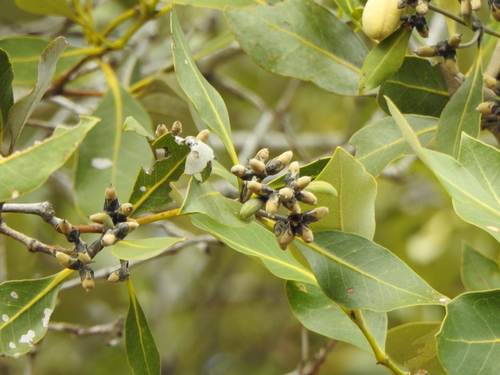
Grey Mangrove
Avicennia marina
The resilient architect of the coastline, the Grey Mangrove creates a bustling metropolis for wildlife between the land and the sea. Its iconic 'snorkel' roots and salt-crusted leaves make it a fascinating subject for any coastal nature enthusiast.
Quick Identification
Size
Typically 3–10 metres (10–33 feet) tall, but can reach 14 metres (46 feet) in tropical conditions.
Colors
Pale grey to whitish bark; glossy olive-green leaf tops with silvery-white or grey undersides; small orange to yellow flowers.
Key Features
- Upright, pencil-like breathing roots (pneumatophores) emerging from the mud
- Salty-tasting leaves with visible salt crystals on the surface
- Smooth, light grey bark that may flake in older specimens
- Small, fragrant four-petaled flowers in dense clusters
When You’ll See Them
Geographic range
Where Does the Grey Mangrove Live?
The Grey Mangrove boasts one of the widest distributions of any mangrove species, primarily native to the Indo-Pacific region. It thrives along the coastlines of East Africa and the Red Sea, stretching across the shores of the Indian subcontinent and Southeast Asia. Its range extends significantly into the temperate zones of Australia and New Zealand, making it one of the most cold-tolerant mangrove species in the world.
Basemap © OpenStreetMap contributors
Behavior
The Grey Mangrove is a master of adaptation, living in the harsh, oxygen-poor environment of the intertidal zone. Unlike most plants, it has evolved a complex system of aerial roots called pneumatophores. These act like snorkels, poking up through the mud to draw in oxygen during low tide. This allows the tree to survive in waterlogged soil where other species would essentially drown.
Its 'behavior' is largely defined by its salt management. As a halophyte, it can thrive in high-salinity environments by filtering out salt through its roots or excreting excess salt through specialized glands on its leaves. If you look closely at a leaf, you will often see shimmering salt crystals on the surface. Its reproductive strategy is equally fascinating; it practices cryptovivipary, where the seed germinates while still attached to the parent tree, allowing it to take root quickly once it drops into the tide.
EverydayEarth exclusive
Camera Tips
Capturing the Grey Mangrove with an AI-powered camera is less about the tree moving and more about the incredible ecosystem that lives within its branches and roots. To get the best shots, mount your camera on a stable, waterproof tripod or a nearby pier piling overlooking the 'breathing roots' (pneumatophores). Since these areas are prone to flooding, ensure your camera housing is rated for high humidity and salt spray.
The most action occurs during the transition between high and low tide. Set your camera to a time-lapse mode or use motion-triggering focused on the mudflat at the base of the tree. This is where you will capture the 'backyard' wildlife of the coast—fiddler crabs emerging to feed, mudskippers climbing the roots, and wading birds like herons or egrets stalking prey between the stems. Aim the camera at a downward 45-degree angle to capture the interaction between the roots and the ground.
For the best lighting, utilize the 'golden hour' at sunrise or sunset. The light reflects beautifully off the glossy leaves and the wet mud. If you are looking for pollinators, focus your lens on the flower clusters during the summer months. Small honeyeaters and various insects are frequent visitors to the fragrant orange blooms. Because the environment is highly reflective due to water and mud, you may need to adjust your exposure settings downward to avoid 'blown out' highlights.
Similar Species
Species that look similar or are commonly confused with Grey Mangrove.
Frequently Asked Questions
Record Grey Mangrove at your habitat
Connect a camera to start building your own species record — AI identifies every visitor automatically.