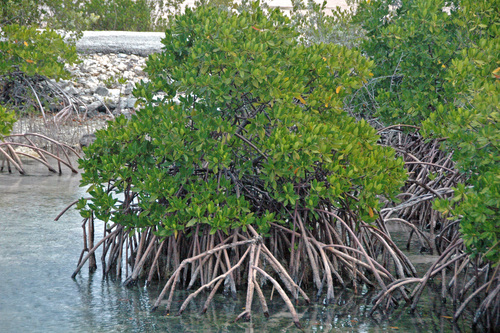
red mangrove
Rhizophora mangle
Meet the 'walking tree' of the coast. The red mangrove is a resilient architect of the shoreline, using its iconic stilt roots to build islands and protect our coastal communities.
Quick Identification
Size
Typically 15 to 30 feet (5–10 m) tall, but can reach 80 feet (25 m) in tropical climates. Propagules (seedlings) are 6–12 inches (15–30 cm).
Colors
Waxy dark green leaves, reddish-brown bark with a greyish tint, and pale yellow to cream-colored flowers.
Key Features
- Arching aerial 'prop roots' that grow into the water
- Cigar-shaped viviparous propagules that germinate while on the tree
- Thick, leathery, elliptical leaves arranged in opposite pairs
- Distinctive red inner bark visible when the trunk is scraped
When You’ll See Them
Geographic range
Where Does the red mangrove Live?
The red mangrove is a staple of the tropical and subtropical Atlantic and East Pacific coastlines. It is most abundantly found in southern Florida, the Caribbean Islands, and the coastal stretches of Mexico and Central America. Its range extends deep into South America as far as Brazil and Peru, and it also occupies a significant portion of the West African coastline from Senegal to Angola.
Basemap © OpenStreetMap contributors
Behavior
The red mangrove is often called the 'walking tree' because its extensive system of arching prop roots makes it appear as though it is stepping into the sea. These roots are more than just structural supports; they are complex biological filters that allow the tree to thrive in salt water while excluding up to 99% of the salt. Small pores on the roots, called lenticels, allow the plant to breathe oxygen in the anaerobic, waterlogged mud of the intertidal zone.
A standout behavior is its reproductive strategy, known as vivipary. Instead of shedding dormant seeds, the red mangrove produces 'propagules' that grow into fully formed seedlings while still attached to the parent tree. When they finally drop, they are already prepared to float for months across oceans or spear directly into the mud at low tide to begin growing immediately. This resilience makes them the primary 'pioneer' species in coastal succession.
EverydayEarth exclusive
Camera Tips
When setting up an AI-powered camera to capture the red mangrove, the goal is to document the ecosystem it supports. Position your camera at a low angle, roughly 12–24 inches above the high-tide line, focusing on a dense cluster of prop roots. This 'root-level' view is the best way to capture the diverse wildlife—such as mangrove tree crabs, snails, and salt marsh snakes—that use the roots as a highway. Ensure your camera mount is extremely secure; screw-in mounts are preferred over straps, as tidal surges and high humidity can cause straps to loosen over time.
Time-lapse photography is the most effective way to showcase the beauty of the red mangrove. Set your camera to take a frame every 10 to 15 minutes. Over a full day, this will reveal the dramatic 'breathing' of the forest as the tide rises to submerge the roots and then retreats. This setting also captures the slow but steady growth of the cigar-shaped propagules during the summer months. Because these trees live in high-salt environments, it is vital to use a waterproof housing and wipe the lens with a microfiber cloth and fresh water weekly to prevent salt crusting from blurring your images.
For the best lighting, aim for the 'golden hours' of dawn and dusk when the sun hits the waxy leaves, creating a vibrant green glow that contrasts against the dark, muddy water. Avoid using heavy flashes at night, as the reflective surface of the waxy leaves can cause extreme overexposure in your shots. If your camera has motion-trigger zones, set them specifically around the horizontal prop roots where birds like the Yellow-crowned Night Heron are likely to perch and hunt.
Similar Species
Species that look similar or are commonly confused with red mangrove.
Black Mangrove
Features dark bark and pencil-like roots (pneumatophores) that grow upward from the soil rather than arching prop roots.
White Mangrove
Lacks visible aerial roots and has rounded leaves with two small salt glands at the base of the leaf stalk.
Buttonwood
An upland mangrove associate that produces button-like fruit and lacks the distinctive prop roots or salt-filtering root systems.
Frequently Asked Questions
Record red mangrove at your habitat
Connect a camera to start building your own species record — AI identifies every visitor automatically.