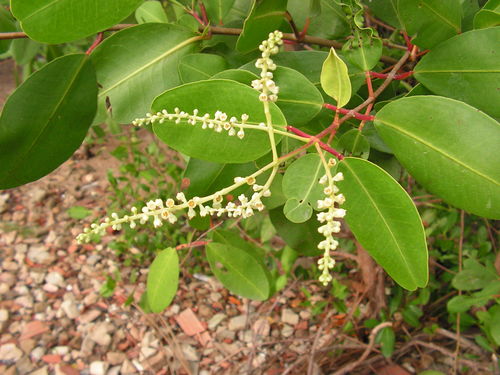
White Mangrove
Laguncularia racemosa
The White Mangrove is the coastal architect of the subtropics, known for its unique salt-secreting glands and its vital role in protecting shorelines. A hardy survivor, it thrives where land meets the sea, providing a sanctuary for birds, crabs, and juvenile fish.
Quick Identification
Size
Typically 10-15 meters (33-50 feet) in height, though it can grow as a multi-stemmed shrub in less favorable conditions. Leaves are 3-7 cm (1.2-2.8 inches) long.
Colors
Light green to yellowish-green foliage; dark, fissured grayish-brown bark; tiny white or greenish-white flowers; and greenish-brown ribbed fruits.
Key Features
- Two small, visible salt-excreting glands at the base of each leaf
- Rounded or oval-shaped leaves with an identical top and bottom surface
- Flattened, velvet-textured, ribbed seed pods
- Smooth, grayish bark that becomes thick and fissured with age
- Usually lacks the prominent prop roots or snorkel-like pneumatophores of other mangroves
When You’ll See Them
Geographic range
Where Does the White Mangrove Live?
The White Mangrove is native to the tropical and subtropical shores of the Atlantic and Pacific Oceans. In the Western Hemisphere, its range extends from the coastal reaches of Florida and the Gulf of Mexico, down through the Caribbean and Central America to southern Brazil and northern Peru. Across the Atlantic, it is a common sight along the western coast of Africa, stretching from Senegal south to Angola.
Basemap © OpenStreetMap contributors
Behavior
The White Mangrove is a resilient coastal pioneer, often found growing further inland than its red and black counterparts. Unlike many other mangrove species, it possesses a unique system for managing salt intake: two distinct glands (nectaries) located on the leaf stem (petiole) that excrete excess salt and sugar. This strategy allows it to thrive in saline environments where other plants would wither. In terms of social structure, it often forms dense thickets or mixed forests, providing a critical buffer against storm surges and coastal erosion.
Ecologically, the White Mangrove acts as a nursery and a sanctuary. It is a 'foundational' species that creates a complex 3D habitat for both terrestrial and aquatic life. While it doesn't move, it interacts dynamically with the tides, shedding leaves that become the base of the coastal food web. For humans, it is a silent protector of the shoreline, though it is often overlooked in favor of the more visually striking Red Mangrove with its 'walking' roots.
EverydayEarth exclusive
Camera Tips
Capturing the White Mangrove with a trail camera requires a focus on the ecosystem it supports rather than just the tree itself. Position your camera at a low angle near the base of the trunk or on a sturdy branch overlooking the water. Because these trees are often in tidal zones, ensure your camera housing is waterproof and mounted high enough to avoid being submerged during king tides or storm surges. Use a wide-angle lens to capture the interplay between the light filtering through the canopy and the water below.
To see the 'wildlife' aspect, target the branches for bird activity. Mangrove Cuckoos, Yellow Warblers, and various herons frequent these trees. If your camera has a time-lapse mode, set it to take a photo every 15-30 minutes over a week; this is a fantastic way to visualize the daily tidal shifts and the slow but steady growth of the distinctive ribbed seed pods. During the flowering season, macro settings can help capture the diverse array of pollinators, including bees and butterflies, that are attracted to the salt glands and small white blooms.
If you are looking for ground-dwelling visitors, aim your camera at the muddy base of the tree. Many species of crabs, including the Fiddler Crab and Mangrove Tree Crab, use the White Mangrove for shelter. Since these areas can be dark under the canopy, a camera with high-quality infrared (no-glow) flash is essential for night shots without scaring off nocturnal foragers like raccoons or opossums that scavenge the shoreline.
Similar Species
Species that look similar or are commonly confused with White Mangrove.
Red Mangrove
Features distinctive reddish 'prop roots' that grow into the water and pointed leaves without salt glands on the stem.
Black Mangrove
Identified by its 'pencil roots' (pneumatophores) that stick up from the mud and leaves that are silvery-white on the underside.
Buttonwood
Often found with mangroves but lacks the specialized salt-management glands and produces round, button-like fruit clusters.
Frequently Asked Questions
Record White Mangrove at your habitat
Connect a camera to start building your own species record — AI identifies every visitor automatically.