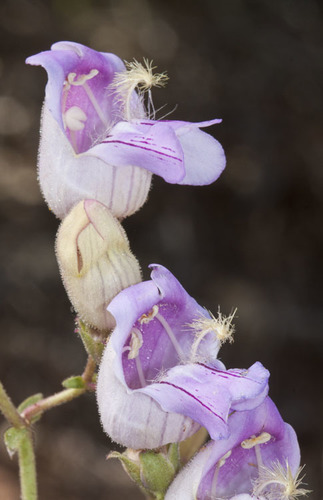
Grinnell's Beardtongue
Penstemon grinnellii
A stunning California endemic, Grinnell's Beardtongue lights up rocky mountain slopes with its delicate violet blossoms and iconic 'hairy' throat. It is a vital high-elevation nectar source for hummingbirds and native bees alike.
Quick Identification
Size
Grows 30 to 85 cm (12 to 33 inches) in height with flowers 1 to 2 cm (0.4 to 0.8 inches) long.
Colors
Pale violet to purple-tinged white petals with dark purple nectar guide lines and a yellow-haired staminode.
Key Features
- Upright stems up to 33 inches tall
- Tubular violet or white flowers with dark 'nectar guide' streaks
- Prominent hairy, protruding staminode (the 'beard')
- Oblong leaves folded lengthwise and curved backward
When You’ll See Them
Geographic range
Where Does the Grinnell's Beardtongue Live?
Grinnell's Beardtongue is a proud California endemic, found nowhere else in the world. Its range spans the state's major mountain corridors, from the coastal ranges near the San Francisco Bay Area through the high Sierra Nevada and down into the Peninsular Ranges near the border with Mexico. It is most frequently encountered in the transition zones where alpine forests meet dry, sun-drenched scrubland.
Basemap © OpenStreetMap contributors
Behavior
As a key nectar source, it has a symbiotic relationship with local wildlife. Its tubular shape is perfectly evolved for long-tongued bees and hummingbirds. When a pollinator enters the flower to reach the nectar, it brushes against the 'beardtongue'—a sterile stamen (staminode) covered in stiff hairs—which ensures that pollen is effectively transferred to the visitor's body. In backyard settings or trail edges, it is a resilient species that thrives on neglect, provided it has the rocky, well-draining soil it craves.
EverydayEarth exclusive
Camera Tips
To capture the best images of Grinnell’s Beardtongue, place your AI camera on a short tripod or ground stake about 12 to 18 inches high. Angle the lens slightly upward to look into the 'throat' of the flower, which reveals the dark purple nectar guides and the signature hairy staminode. Because this plant is a magnet for hummingbirds and large carpenter bees, use a camera with a high-speed trigger or a 'burst' mode to capture the fast-moving visitors that this plant attracts.
Since the flowers are a pale lavender or white, they can easily become overexposed in the harsh midday mountain sun. Set your camera to be most active during the 'Golden Hours'—shortly after sunrise and just before sunset—when the soft, angled light makes the violet hues pop and highlights the glandular hairs on the stem. If you are using a trail camera, look for a patch of plants on a rocky outcropping where the background is distant; this creates a beautiful natural bokeh effect that makes the flower spikes stand out.
For those interested in the 'wildlife' aspect of the plant, time-lapse mode is your best friend. Set the camera to take a photo every 15 minutes during the peak bloom in June. This will not only document the flowers opening but also reveal the sheer volume of insect traffic the plant supports. Avoid using heavy baits near the plant, as deer and rabbits may be tempted to graze on the foliage, potentially damaging your subject before it fully blooms.
Similar Species
Species that look similar or are commonly confused with Grinnell's Beardtongue.
Frequently Asked Questions
Record Grinnell's Beardtongue at your habitat
Connect a camera to start building your own species record — AI identifies every visitor automatically.