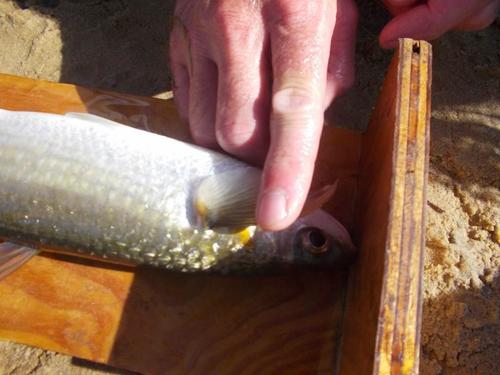
Grooved Mullet
Chelon dumerili
A shimmering acrobat of the African coastlines, the Grooved Mullet is famous for its synchronized schooling and its impressive ability to leap clear of the water's surface.
Quick Identification
Size
Typically 20 to 30 cm (8 to 12 inches) in length, with larger individuals reaching a maximum of approximately 40 cm (16 inches).
Colors
Bright silvery sides transitioning to a greyish-olive or blue-grey back; the belly is pale or white, and a faint golden spot is often visible on the operculum (gill cover).
Key Features
- Deep horizontal groove on the upper lip
- Two widely separated dorsal fins
- Broad, flattened head with large scales
- Lack of a visible lateral line along the body
When You’ll See Them
Geographic range
Where Does the Grooved Mullet Live?
The Grooved Mullet is a coastal specialist primarily found along the eastern Atlantic shores of Africa. Its native range stretches from the northern waters of Mauritania, winding down the diverse coastlines of West Africa past the Gulf of Guinea to the southern reaches of South Africa. Beyond the Atlantic, this resilient fish also occupies the western Indian Ocean, notably appearing in the brackish lagoons and estuaries of Mozambique. It is most at home in shallow environments where freshwater and seawater mix, such as river deltas and coastal mangroves.
Basemap © OpenStreetMap contributors
Behavior
The Grooved Mullet is a highly social and active fish, typically found moving in large, coordinated schools. They are well-known for their remarkable ability to leap high out of the water, a behavior thought to help them escape predators or possibly clear their gills in oxygen-poor environments. This species is euryhaline, meaning it can tolerate a wide range of salinity levels, allowing it to move freely between the salty ocean, brackish lagoons, and nearly fresh river mouths.
In terms of social interaction, these fish are generally peaceful and non-aggressive, focusing their energy on communal foraging along the seabed. While they are often wary of humans and will scatter at the splash of a paddle or a sudden shadow, they are a common sight for coastal residents and fishermen. They play a vital role in the ecosystem by processing detritus and serving as a primary food source for larger marine predators and coastal birds.
EverydayEarth exclusive
Camera Tips
To capture the Grooved Mullet, you will need a specialized underwater camera housing or an action camera rated for marine environments. Because these fish prefer shallow, turbid waters like estuaries, visibility can be a challenge. Place your camera near the bottom in a sandy or silty area where you see 'feeding pits'—small depressions in the sand where mullets have been vacuuming up detritus. An angle looking slightly upward toward the surface can capture the silvery shimmer of the school as they pass by.
If your backyard overlooks a lagoon or canal, you can capture their famous jumping behavior using a high-speed trail camera mounted on a dock or piling. Aim the camera parallel to the water's surface at a height of about 1 meter (3 feet). Use a wide-angle lens and a fast shutter speed to freeze the action, as their leaps are incredibly quick. Early morning light provides the best illumination without the harsh midday glare reflecting off the water.
Since mullets are detritivores, traditional bait doesn't work well for 'luring' them to a camera. Instead, look for natural bottlenecks in their environment, such as the mouth of a tide pool or a narrow channel between mangroves. During the incoming tide, these fish move into shallower areas to feed, making this the peak time for your AI camera to trigger. Ensure your camera is secured against tidal currents using a weighted tripod or a strap fixed to a submerged structure.
Similar Species
Species that look similar or are commonly confused with Grooved Mullet.
Frequently Asked Questions
Record Grooved Mullet at your habitat
Connect a camera to start building your own species record — AI identifies every visitor automatically.