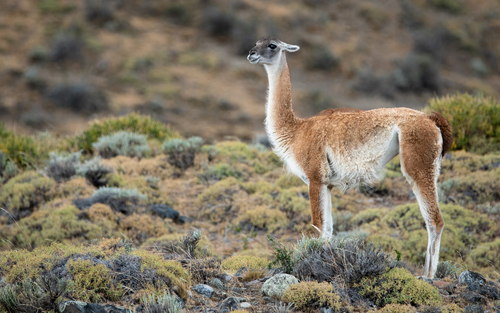
Guanaco
Lama guanicoe
The wild ancestor of the llama, the Guanaco is the elegant sentry of the South American plains. Known for its incredible speed and resilience, this auburn-coated camelid thrives where few others can.
Quick Identification
Size
Standing 1.0–1.3 m (3.3–4.3 ft) at the shoulder with a total body length of 2.1 m (6.9 ft); weight ranges from 90 to 140 kg (200–310 lbs).
Colors
Tawny or reddish-brown upper body with a contrasting white underbelly, neck, and inner legs; faces are typically dark grey to black.
Key Features
- Slender, elegant neck and long legs
- Large, pointed ears and dark, expressive eyes
- Thick, wooly double-coat
- Cleft upper lip designed for precise grazing
When You’ll See Them
Geographic range
Where Does the Guanaco Live?
The Guanaco is a quintessential icon of the South American wilderness, found primarily along the rugged spine of the Andes and the vast, wind-swept plains of Patagonia. While they are most abundant in Argentina and Chile, smaller, more fragmented populations persist in the high-altitude deserts of Peru, Bolivia, and the western reaches of Paraguay. These adaptable camelids thrive across a staggering variety of terrains, from the arid Atacama Desert to the lush, wet forests of Tierra del Fuego.
Basemap © OpenStreetMap contributors
Behavior
Guanacos are highly social animals that live in organized herds, typically led by a single dominant male who protects a group of females and their young, known as 'chulengos.' You might also encounter 'bachelor' groups consisting of young males waiting to establish their own territories. They are incredibly hardy and alert, often using a high-pitched bleating alarm call to warn the herd of approaching predators like pumas or Andean foxes.
These camelids are remarkably fast and agile, capable of running at speeds up to 56 km/h (35 mph) and swimming across chilly Patagonian rivers. While they are generally wary of humans, they have a fascinating defense mechanism: they can spit digestive juices and saliva with surprising accuracy if they feel threatened or cornered. Their daily life revolves around a cycle of grazing and resting, often moving between higher and lower elevations depending on the season and forage availability.
EverydayEarth exclusive
Camera Tips
To capture high-quality footage of Guanacos, position your camera along established game trails or near natural water sources, especially in arid regions like the Atacama or northern Patagonia. Because they are tall animals, mount your camera approximately 1.2 meters (4 feet) off the ground and angle it slightly downward. This ensures you capture their full profile and distinctive facial markings rather than just their legs.
Guanacos are most active during the daylight hours, so prioritize cameras with high-resolution daytime sensors. Since they move in herds, set your camera to 'Burst Mode' or increase your video length to 20-30 seconds; this allows you to see the social hierarchy as the dominant male usually leads or trails the group. Avoid placing cameras in areas with extremely high winds without a heavy-duty mount, as the swaying of nearby shrubs can trigger false recordings.
In terms of settings, use a fast trigger speed (0.3 seconds or less) because Guanacos can be surprisingly quick when they are spooked or simply moving between grazing spots. If you are placing a camera in a backyard or ranch setting near their habitat, they are often attracted to salt licks or fresh alfalfa, though they are naturally wary of new objects. Give the camera a few days to 'weather' so any human scent dissipates before you expect high-traffic activity.
Similar Species
Species that look similar or are commonly confused with Guanaco.
Frequently Asked Questions
Record Guanaco at your habitat
Connect a camera to start building your own species record — AI identifies every visitor automatically.