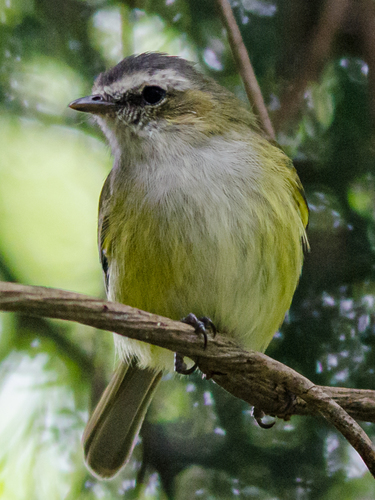
Guatemalan Tyrannulet
Zimmerius vilissimus
A pint-sized powerhouse of the Central American highlands, the Guatemalan Tyrannulet is a master of the canopy. Known for its love of mistletoe and its tireless energy, this little green bird is a frequent visitor to well-planted gardens.
Quick Identification
Size
Length: 9.5–10.5 cm (3.7–4.1 in); Weight: 7–10 g (0.25–0.35 oz)
Colors
Dull olive-green upperparts, greyish crown, and pale yellow to whitish underparts. Wings show prominent yellow feather edging.
Key Features
- Tiny, energetic flycatcher with a short, dark bill
- Yellowish edging on wing coverts and flight feathers
- Greyish-olive crown that contrasts with a greener back
- Faint, pale yellowish eyebrow (supercilium)
When You’ll See Them
Geographic range
Where Does the Guatemalan Tyrannulet Live?
The Guatemalan Tyrannulet is native to the highland regions of northern Central America. Its core range extends from the southern Mexican state of Chiapas through the mountainous interiors of Guatemala, El Salvador, and into southern Belize. It is a resident species throughout its range, thriving in moist, subtropical environments where the forest meets open clearings.
Basemap © OpenStreetMap contributors
Behavior
The Guatemalan Tyrannulet is a restless and highly active small bird, rarely staying in one spot for more than a few seconds. Unlike many flycatchers that 'sally' out to catch insects in mid-air, this species prefers to glean its prey directly from leaves or hover briefly to pluck small fruits. They are particularly famous for their specialized diet, often centering their territories around mistletoe plants.
Socially, they are typically seen alone or in pairs. While they don't usually join large mixed-species flocks, they are not particularly shy of humans and can be found in well-planted suburban gardens or coffee plantations. Their presence is often detected by their voice—a persistent, high-pitched, downslurred 'pee-yurr' call that carries surprisingly well through the forest canopy.
EverydayEarth exclusive
Camera Tips
Capturing the Guatemalan Tyrannulet on an AI camera requires a strategy focused on their specific foraging habits. Because they are small and move quickly through the canopy, placing your camera near 'magnet' plants is essential. Look for mistletoe clusters or small-berried shrubs; these birds are remarkably loyal to productive fruit sources and will return to the same branches multiple times a day.
Mount your camera at a height of 5 to 8 feet, ideally angled slightly upward into the mid-story where these birds spend most of their time. Since they are tiny and lightweight, set your camera's PIR (motion) sensitivity to its highest setting to ensure the sensor triggers. A fast trigger speed is critical, as they often hover for just a second before moving to the next leaf.
Early morning is the best time for activity, so ensure your camera is positioned to avoid direct eastern glare. If you have a garden water feature, especially one with a gentle drip or misting function, place a camera there as well. These birds are frequent bathers, and the slow-motion video of a Guatemalan Tyrannulet in a birdbath is one of the most rewarding captures for any backyard researcher.
Similar Species
Species that look similar or are commonly confused with Guatemalan Tyrannulet.
Mistletoe Tyrannulet
Very similar but found further south (Nicaragua to Panama); it was formerly considered the same species as the Guatemalan Tyrannulet.
Yellow-bellied Elaenia
Much larger with a noticeable crest and distinct white wing bars, whereas the Tyrannulet is smaller with yellow wing edging.
Frequently Asked Questions
Record Guatemalan Tyrannulet at your habitat
Connect a camera to start building your own species record — AI identifies every visitor automatically.