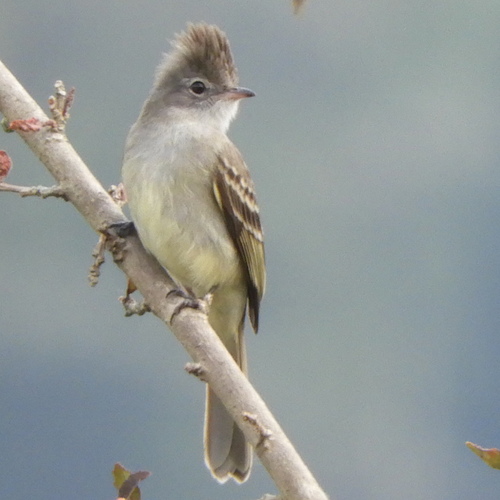
Yellow-bellied Elaenia
Elaenia flavogaster
The Yellow-bellied Elaenia is the charismatic 'punk rocker' of the tropical garden, recognizable by its spiky crest and noisy, bold attitude. A frequent visitor to backyards, this adaptable flycatcher is as likely to be seen snatching a berry as it is a bug.
Quick Identification
Size
Length: 16–17.5 cm (6.3–6.9 in); Wingspan: 23–26 cm (9–10 in); Weight: 21–29 g (0.7–1.0 oz)
Colors
Olive-brown upperparts, grayish throat and breast, and a distinctive pale sulfur-yellow belly. Two prominent white wing bars and a thin, broken white eye-ring.
Key Features
- Bushy, 'messy' crest often split into two peaks
- Pale yellow belly contrasting with a grayish chest
- Two distinct white wing bars on dark wings
- White patch at the base of the crown feathers, usually hidden unless the bird is excited
When You’ll See Them
Behavior
While they are named flycatchers, they spend a significant amount of time foraging for fruit. Their flight is direct but they often incorporate a 'hover-glean' maneuver, where they briefly flutter in front of a leaf or twig to pluck an insect or a berry. They are generally social with their mates but can be quite cantankerous toward other species, making them easy to spot due to the commotion they create in the canopy.
EverydayEarth exclusive
Camera Tips
Mount your AI camera between 4 to 7 feet high, as this species typically occupies the mid-story of gardens and forest edges. Angling the camera slightly upward toward a fruiting shrub like a Melastome or a Mistletoe cluster can result in fantastic feeding footage. Since they are extremely quick, set your camera to its highest trigger speed and consider a video setting with a high frame rate to capture the detail of their 'hover-gleaning' behavior without motion blur.
Seasonal timing is also key for backyard filming. During the nesting season, they become much more repetitive in their flight paths, often carrying nesting materials like lichen and spiderwebs to a cup-shaped nest hidden in a fork of a tree. If you identify a nesting pair, position the camera at a respectful distance (at least 15-20 feet) with a zoom lens if possible. Because their yellow belly is quite pale, avoid placing the camera in direct, harsh midday sun which can 'blow out' the highlights on their chest; early morning or late afternoon light provides the best saturation for their subtle colors.
Similar Species
Species that look similar or are commonly confused with Yellow-bellied Elaenia.
Lesser Elaenia
Smaller with a more rounded head and lacks the large, messy crest of the Yellow-bellied.
White-crested Elaenia
Very similar but has a more prominent and frequently visible white crown stripe and a clearer, whistled song.
Greenish Elaenia
Lacks the distinct crest and yellow belly, appearing more uniformly olive-green with a flatter head shape.
Frequently Asked Questions
Record Yellow-bellied Elaenia at your habitat
Connect a camera to start building your own species record — AI identifies every visitor automatically.