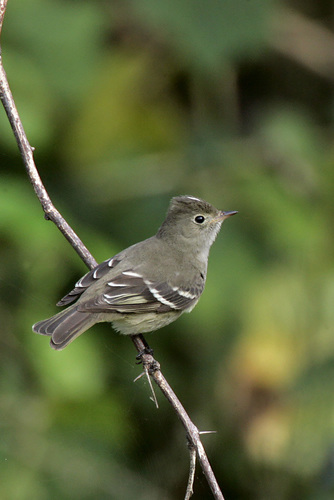
White-crested Elaenia
Elaenia albiceps
A master of the 'fio-fio' whistle, the White-crested Elaenia is a charismatic summer visitor to South American gardens. Watch closely for the moment it raises its crown feathers to reveal its secret, snowy-white crest.
Quick Identification
Size
Length: 13.5–15 cm (5.3–6 in); Weight: 11–18 g (0.4–0.6 oz); Wingspan: 20–23 cm (8–9 in)
Colors
Olive-grey upperparts, pale greyish-white throat, and a yellowish or pale belly. Features two distinct white wing bars and a hidden white patch on the crown.
Key Features
- Semi-concealed white crown patch often visible only when excited
- Two prominent white wing bars on dark wings
- Small, pointed bill with a pinkish or pale base on the lower mandible
- Distinctive 'fio-fio' whistling call
When You’ll See Them
Behavior
The White-crested Elaenia is a spirited and highly vocal member of the flycatcher family. In South America, particularly in Chile and Argentina, it is affectionately known as the 'Fio-fio' due to its repetitive, whistling call that echoes through gardens and woodlands during the spring and summer. These birds are quite active and restless, rarely staying in one spot for long as they flit between branches in search of food.
While they are technically tyrant flycatchers, they are remarkably social and tolerant of human presence, frequently nesting in backyard fruit trees or ornamental shrubs. They are austral migrants, meaning southern populations travel long distances north toward the Amazon basin during the winter months, returning south to breed when the weather warms. When territorial or agitated, they will raise their head feathers, revealing the brilliant white 'hidden' crest that gives them their name.
EverydayEarth exclusive
Camera Tips
To capture high-quality footage of the White-crested Elaenia, position your camera at a height of 5 to 8 feet, ideally aimed toward the mid-story of a leafy tree or a fruiting shrub. These birds are particularly drawn to 'Maqui' or 'Berberis' bushes when the berries are ripe. Because they are fast-moving, use a camera with a high frame rate (60fps if possible) and a fast trigger speed to avoid capturing a blur as they dart after insects. If your camera allows for focal distance adjustments, set it for 3-5 feet and place the camera near a favorite perching branch.
Water is a major draw for this species. Unlike many shy forest birds, the White-crested Elaenia will readily visit a backyard birdbath or a shallow dripping water feature. Setting up your camera at ground level or slightly elevated near a water source, with the sun at your back, will provide the best lighting to highlight the subtle olive tones of their plumage and the white of their wing bars. Early morning light is especially flattering for these birds.
Because the white crest is only revealed during specific behaviors—like singing, defending territory, or responding to a call—consider using a camera that supports video with sound. The bird is most likely to display its crest while vocalizing. During the breeding months of November and December, they are much more stationary near nesting sites, which are usually cup-shaped nests hidden in the forks of branches. If you locate a nest, keep your distance and use a telephoto lens or a well-concealed remote camera to avoid disturbing the parents.
Finally, keep in mind their migratory schedule. If you are in the southern part of their range, ensure your cameras are active and batteries are fresh starting in late September. They arrive with a burst of energy and vocalization, making them much easier to track and film during these first few weeks of the spring season than during the quieter late summer months.
Similar Species
Species that look similar or are commonly confused with White-crested Elaenia.
Frequently Asked Questions
Record White-crested Elaenia at your habitat
Connect a camera to start building your own species record — AI identifies every visitor automatically.