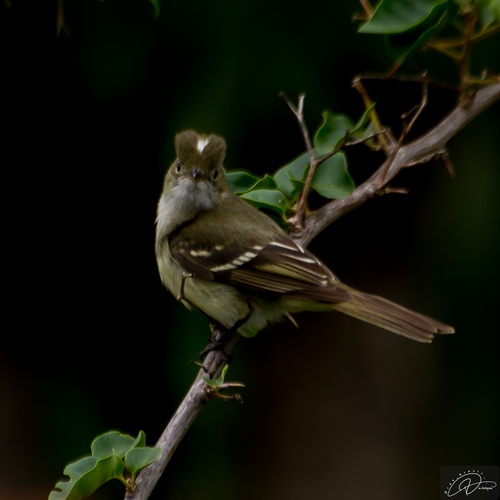
Small-billed Elaenia
Elaenia parvirostris
A subtle gem of the South American woodlands, the Small-billed Elaenia is a master of aerial maneuvers. Watch for its bushy crest and signature 'sallying' flight as it patrols the garden for insects.
Quick Identification
Size
Length: 14–15 cm (5.5–6 in); Weight: 12–16 g (0.4–0.6 oz); Wingspan: 22–24 cm (8.5–9.5 in)
Colors
Dull olive-gray upperparts, grayish-white throat, and a pale yellow to white belly. Features two distinct white wing bars.
Key Features
- Short, stubby black bill
- Two prominent white wing bars
- Bushy olive crest, often hiding a white crown patch
- Upright perching posture
When You’ll See Them
Behavior
The Small-billed Elaenia is a restless and active member of the tyrant flycatcher family. It is best known for its 'sit-and-wait' hunting style, where it perches on an exposed outer branch, scanning the air for passing insects. Unlike some of its more aggressive relatives, this species tends to be more discreet, moving through the canopy with quick, nimble flights.
While they are primarily solitary or found in pairs, they are famous for their long-distance migration. As 'austral migrants,' they breed in the temperate regions of southern South America and fly north toward the Amazon basin and Caribbean coast for the winter. During these journeys, they are more likely to appear in suburban gardens and parks, often announcing their presence with a distinctive, burry whistle.
EverydayEarth exclusive
Camera Tips
To capture high-quality footage of the Small-billed Elaenia, focus your camera on 'staging branches'—the thin, horizontal twigs that stick out from the edge of a dense thicket or hedge. These birds love to use these spots as lookout points before diving for an insect. Position your camera about 4 to 6 feet off the ground, aiming at a branch with a clean, uncluttered background to help the bird's olive-gray plumage stand out.
Water is a major draw for this species. Unlike larger birds that spend a long time splashing, the Small-billed Elaenia often prefers a 'moving water' feature like a solar fountain or a dripper. Set your camera's trigger speed to its fastest setting and use a high-frame-rate video mode if possible; their movements at the water's edge are lightning-fast and can easily appear as a blur on standard settings.
If you are trying to attract them to a specific spot for a trail camera, focus on habitat rather than traditional feeders. They will not visit seed or suet feeders, but they are highly attracted to native berry-producing shrubs. Planting species like Lantana or small-fruited nightshades will create a natural 'bait station' that keeps them coming back to the same spot throughout the day.
Lighting is crucial for identifying this species on camera. Their field marks, like the white wing bars and the subtle yellow wash on the belly, can be washed out in direct midday sun. Position your camera to face north or south to avoid lens flare, and try to capture them in the dappled light of early morning. This softer light brings out the olive tones and makes the crest more visible when they raise it in excitement.
Similar Species
Species that look similar or are commonly confused with Small-billed Elaenia.
Frequently Asked Questions
Record Small-billed Elaenia at your habitat
Connect a camera to start building your own species record — AI identifies every visitor automatically.