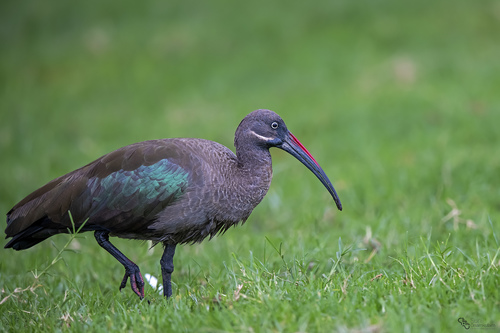
Hadada Ibis
Bostrychia hagedash
Africa's most famous feathered alarm clock, the Hadada Ibis, is a master of the suburban safari. With its iridescent wings and unmistakable voice, it brings a touch of wild African savanna right into the backyard.
Quick Identification
Size
Length: 65–76 cm (26–30 in). Weight: 1–1.3 kg (2.2–2.9 lbs). Wingspan: 100–110 cm (39–43 in).
Colors
Dull olive-to-grey-brown body plumage with striking iridescent green and purple patches on the wing coverts. Dark bill often showing a red stripe on the upper mandible.
Key Features
- Extremely loud, raucous 'ha-da-da' call
- Iridescent green and bronze wing patches
- Long, downward-curving black bill
- White-to-pale horizontal stripe across the cheek
- Stout, dark grey legs
When You’ll See Them
Sightings on EverydayEarth
Jun 25, 2026
A juvenile hippopotamus rests calmly in the mud at the edge of a watering hole. Nearby, a Hadada Ibis forages in the shallows, probing the soft ground with its long bill.
Jun 25, 2026
A large Common Hippopotamus rests in the shallow mud at the edge of a watering hole. In the background, two Hadada Ibises forage in the water; the individual on the left shows striking green iridescence on its wings as it probes the sediment with its curved bill. The hippo remains mostly stationary, occasionally twitching its ears to ward off insects.
Jun 25, 2026
Two Hadada Ibises are foraging in the shallow water at the edge of a watering hole. One bird is actively probing the mud with its long, downward-curved bill, while the other stands nearby, occasionally looking around.
Jun 25, 2026
A Hadada Ibis stands in the shallow, muddy water at the edge of a watering hole. It turns its head to reveal its long, curved bill and probes the sediment for food, with its wings catching the light to show a distinct green shimmer.
Jun 25, 2026
A Hadada Ibis is foraging along the muddy edge of a watering hole. It repeatedly probes the shallow water and mud with its long, curved bill to search for food, occasionally moving its head and taking small steps along the shoreline.
Jun 25, 2026
Two Hadada Ibises are wading through the shallow margins of a watering hole. They are actively probing the mud and water with their long, curved bills in search of food, creating small ripples on the surface.
Geographic range
Where Does the Hadada Ibis Live?
The Hadada Ibis is a widespread resident throughout Sub-Saharan Africa, ranging from the humid forests of West Africa to the savannas of East Africa and the temperate gardens of South Africa. It is particularly common in countries like South Africa, Kenya, Uganda, and Tanzania, where its population has actually expanded significantly due to human-led irrigation and the planting of exotic trees in urban areas. This bird is a true generalist, thriving anywhere from coastal sea levels to highland plateaus.
Basemap © OpenStreetMap contributors
Recorded on EverydayEarth
Behavior
The Hadada Ibis is a highly social and vocal bird, famous across Sub-Saharan Africa for its piercing, trumpet-like calls that signal the beginning and end of the day. While they are often seen in pairs or small family groups, they congregate in larger numbers at communal roosts, typically choosing tall trees near water or in suburban gardens. Unlike many of their more reclusive relatives, Hadadas have adapted remarkably well to human presence, becoming a staple of urban and suburban life.
On the ground, they move with a steady, rhythmic walk, constantly probing the soil with their long, sensitive bills to detect movement. They are bold and often ignore humans from a distance, but if startled, they take flight with heavy, flapping wingbeats and a loud, indignant alarm call. Their daily routine is highly predictable, often following the same flight paths between feeding grounds and roosting sites for years.
EverydayEarth exclusive
Camera Tips
To capture the Hadada Ibis on a backyard camera, you should target open lawn areas, especially those that are regularly irrigated. These birds are ground-feeders that rely on soft soil to probe for worms. Position your camera low—about 30 to 50 centimeters from the ground—and angle it slightly downward. This ensures you catch the bird's head and bill in action as it 'sews' the ground for food. High-traffic areas near sprinklers or damp flower beds are ideal 'hotspots' for placement.
Because Hadadas are most active and vocal at dawn and dusk, configure your camera to take short, high-resolution video clips during these times. Their flight calls are a huge part of their identity, so enabling audio recording is a must to capture the full experience of their presence. They are relatively large and heavy birds, so they will easily trigger most PIR sensors, but setting a short trigger delay will help you capture them as they walk rhythmically across the frame.
While they are accustomed to humans, they have sharp eyesight. Using 'No-Glow' or 'Black' infrared LEDs is recommended if your camera is near their roosting trees to avoid startling them at night. To encourage more frequent visits, focus on lawn health rather than birdseed; avoid using pesticides that kill earthworms and beetle larvae, as these are the primary 'bait' that brings Hadadas into your yard. A simple birdbath on the ground can also attract them for a drink or a quick splash.
Similar Species
Species that look similar or are commonly confused with Hadada Ibis.
Glossy Ibis
Smaller and more slender with a uniform deep maroon-brown body and lacks the loud 'ha-da-da' call.
African Sacred Ibis
Features a white body with a bald black head and neck, looking very different from the brown Hadada.
Olive Ibis
Strictly a forest dweller that is much shyer and darker, rarely found in open gardens.
Frequently Asked Questions
Record Hadada Ibis at your habitat
Connect a camera to start building your own species record — AI identifies every visitor automatically.