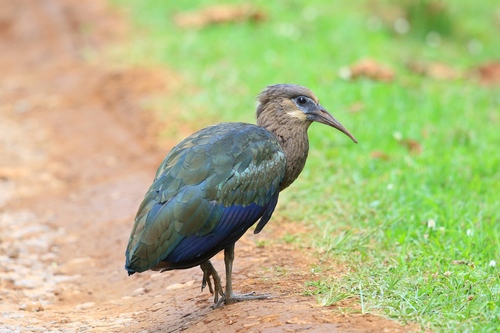
Olive Ibis
Bostrychia olivacea
A master of the African forest shadows, the Olive Ibis is a secretive bird known for its stunning iridescent wings and shaggy crest. Rarely seen by the casual observer, this species is a prized find for backyard trail cameras.
Quick Identification
Size
65–75 cm (25.5–29.5 in) in length; Weight approx. 0.6–0.9 kg (1.3–2.0 lbs)
Colors
Dull olive-brown body with iridescent bronze and green wing coverts; pale wing patch; reddish-brown shaggy crest; dull reddish face.
Key Features
- Distinctive shaggy crest on the nape
- Iridescent bronze-green sheen on wings
- Short, stocky build for an ibis
- Pale horizontal wing stripe visible during flight
When You’ll See Them
Geographic range
Where Does the Olive Ibis Live?
This elusive bird is native to the lush tropical belt of Central and West Africa. Its core range spans across countries such as Gabon, Cameroon, Ivory Coast, and the Democratic Republic of Congo, with isolated populations also found in the highland forests of Kenya and Tanzania. Because it relies on intact, dense forest cover, its distribution is often fragmented, following the remaining corridors of primary tropical growth across the continent.
Basemap © OpenStreetMap contributors
Behavior
The Olive Ibis is a shy and elusive inhabitant of Africa's densest tropical forests. Unlike its more social relatives, this species is often found in pairs or small groups rather than large flocks. It is remarkably secretive, spending much of its day foraging on the forest floor under the shade of thick canopy cover, making it a difficult bird to spot without specialized equipment like motion-activated cameras.
While they are relatively quiet during the day, they are known for their loud, trumpeting calls at dawn and dusk as they fly between their roosting sites and feeding grounds. They are highly territorial over their favorite foraging patches and will return to the same muddy forest streams or swampy depressions day after day to probe for food. At night, they roost high in the canopy, often selecting branches that overhang water for added protection from predators.
EverydayEarth exclusive
Camera Tips
Capturing the Olive Ibis on camera requires a strategic approach focused on forest hydrology. These birds are most predictable near shallow, muddy stream banks or seasonal forest puddles where they probe for grubs. Place your camera 12 to 18 inches off the ground, angled slightly downward toward a muddy clearing or a well-used game trail that leads to water. Because they are shy, ensure the camera is well-camouflaged and avoid using any 'white flash' settings which might startle them permanently from the area; 'no-glow' infrared is essential for this species.
Timing is critical for these forest dwellers. Set your camera's trigger speed to its fastest setting and program it to capture bursts of photos or short videos of 15-20 seconds. They are most active in the very early morning and late afternoon when the light is low, so ensure your camera has a high-quality sensor capable of handling low-light conditions without excessive grain. While traditional baiting isn't effective for ibises, maintaining a small, clear muddy patch near a water source can act as a natural lure during drier periods.
For those living near their habitat, look for 'splatter' marks or distinct probing holes in the mud—these are signs of a regular feeding spot. Position your camera where the light filters through the canopy in the morning; this will highlight the stunning iridescent sheen on their olive feathers, which otherwise look plain dark brown in the shade. During the breeding season, they may be found near specific tall trees used for roosting, so pointing a camera upward toward large horizontal branches overhanging water might catch them at rest.
Similar Species
Species that look similar or are commonly confused with Olive Ibis.
Hadada Ibis
Much more common in open habitats and suburbs; features a white stripe on the cheek and lacks the Olive Ibis's shaggy crest.
Spot-breasted Ibis
Similar forest habitat but distinguished by white spotting on the neck and breast and a lack of the shaggy crest.
Green Ibis
Found only in South and Central America; smaller with a shorter crest and different vocalizations.
Frequently Asked Questions
Record Olive Ibis at your habitat
Connect a camera to start building your own species record — AI identifies every visitor automatically.