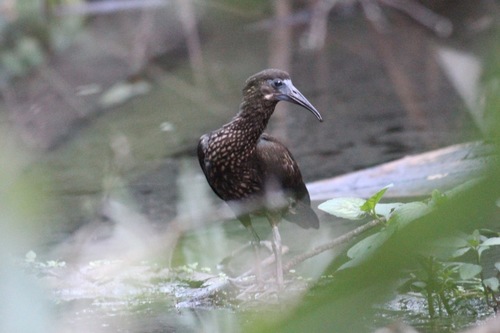
Spot-breasted Ibis
Bostrychia rara
A 'ghost' of the African tropical forest, the Spot-breasted Ibis is a master of camouflage and stealth. With its iridescent wings and signature spotted chest, this elusive bird is one of the most rewarding sightings for any wildlife enthusiast.
Quick Identification
Size
47–52 cm (18.5–20.5 in) in length; weight approx. 450–500g (1–1.1 lbs)
Colors
Dark bronze-brown body with iridescent green and turquoise on wings; distinctive white or buff spots on the breast and neck; dull red or greenish bill.
Key Features
- Bold white or buff spotting across the breast and neck
- Iridescent greenish-blue wing coverts
- Stocky body with relatively short legs for an ibis
- Bare dark facial skin around a curved bill
When You’ll See Them
Geographic range
Where Does the Spot-breasted Ibis Live?
The Spot-breasted Ibis is a native of the tropical humid forests of West and Central Africa. Its range spans from the Upper Guinea forests of Sierra Leone and Liberia through the southern parts of Nigeria, extending deeply into the Congo Basin across Cameroon, Gabon, and the Democratic Republic of the Congo. It is strictly a forest-dependent species, residing in the heart of the continent's most lush equatorial ecosystems.
Basemap © OpenStreetMap contributors
Behavior
The Spot-breasted Ibis is one of Africa’s most secretive avian residents. Unlike its more gregarious cousins that congregate in large flocks, this species is intensely solitary or found only in pairs. It spends most of its day navigating the dense, tangled undergrowth of primary rainforests, making it exceptionally difficult to spot without the aid of specialized camera traps. When disturbed, it typically freezes or quietly slips away into the vegetation rather than taking flight.
These birds are crepuscular, meaning they are most active during the transition periods of dawn and dusk. They spend their nights roosting in the mid-to-high canopy of large forest trees, often overhanging water. Their vocalizations are rarely heard during the day but consist of a loud, raucous 'ha-han' call usually emitted as they fly to and from their roosting sites at twilight.
EverydayEarth exclusive
Camera Tips
Capturing the Spot-breasted Ibis on a trail camera requires targeting their very specific foraging niches. Look for 'micro-wetlands' within the forest—small, stagnant pools or muddy banks along narrow forest streams. These birds prefer areas with thick overhead cover, so avoid placing cameras in large, sunlit clearings. Position your camera low, roughly 12 inches (30 cm) off the ground, and angle it slightly downward to focus on the soft mud where they probe for food.
Because these birds are most active in the low-light conditions of the rainforest floor at dawn and dusk, the quality of your camera's infrared flash is paramount. Use a 'No-Glow' or 'Black Flash' LED system to ensure the bird isn't spooked by the camera's operation. This species is highly sensitive to human presence, so use a high-capacity SD card and high-quality batteries to minimize the frequency of visits to the camera site. The less human scent you leave behind, the more likely the ibis is to continue its routine.
Set your camera to a fast trigger speed (under 0.3 seconds if possible) and use a multi-photo burst mode. The Spot-breasted Ibis moves its head rapidly while probing the soil; a burst of three to five photos increases your chances of getting a clear, blur-free shot of the diagnostic white spots on its chest. While they are not easily attracted by artificial baits, placing your camera near a site with naturally high concentrations of snails or earthworms after a heavy rain will significantly improve your odds.
Similar Species
Species that look similar or are commonly confused with Spot-breasted Ibis.
Frequently Asked Questions
Record Spot-breasted Ibis at your habitat
Connect a camera to start building your own species record — AI identifies every visitor automatically.