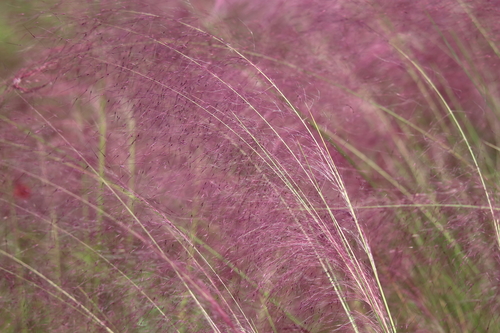
Hairawn Muhly
Muhlenbergia capillaris
Transform your backyard into a dreamy autumn landscape with the misty pink plumes of Hairawn Muhly. This hardy native grass is a favorite for both photographers and local wildlife seeking a cozy place to hide.
Quick Identification
Size
30–90 cm (1–3 ft) tall and 60–90 cm (2–3 ft) wide
Colors
Deep green foliage in summer; vibrant pink to purple flower plumes in fall; copper-tan in winter
Key Features
- Ethereal, cloud-like pink flower panicles
- Dense, clump-forming wiry green foliage
- Vibrant autumn color transition
- Stiff, upright growth habit
When You’ll See Them
Behavior
Hairawn Muhly, often called Pink Muhly Grass, is a warm-season perennial that spends the early half of the year as a modest, neat clump of wiry green blades. As the heat of summer peaks, it prepares for its spectacular fall display. Unlike many garden plants that fade in autumn, this grass thrives as temperatures drop, sending up hazy, delicate flowers that create a pink mist effect over the garden. It is a slow-growing but hardy species that serves as a vital structural element in backyard habitats.
Beyond its visual appeal, the plant acts as a social hub for local wildlife. Its dense, mounded shape provides essential 'resting cover' for small mammals and ground-nesting birds during the day. While it doesn't move in the traditional sense, its responsiveness to wind and light makes it a dynamic presence in any landscape, swaying gracefully even in light breezes and changing appearance drastically from morning dew to evening sunset.
EverydayEarth exclusive
Camera Tips
To capture the iconic 'pink cloud' of Hairawn Muhly, placement is everything. The flower plumes are semi-transparent, meaning they look best when back-lit. Position your camera so it faces East or West; this allows the low-angled sun of the morning or evening to shine through the fibers, making the plant appear to glow from within. If your camera is placed in a spot where the sun is behind the lens, the colors will look flatter and less vibrant.
Since this grass is a magnet for small creatures like sparrows, wrens, and rabbits, set your camera at a 'critter-level' height of about 12 to 15 inches from the ground. Aim the lens at the base of the clump or a small clearing right next to it. Many birds use the dense foliage as a staging area before hopping out to find seeds or insects, making the perimeter of the Muhly a high-traffic zone for motion-activated triggers.
Be mindful of the wind when configuring your AI camera settings. The fine, feathery plumes of Hairawn Muhly are extremely sensitive to movement. On a breezy day, this can lead to hundreds of 'false' triggers. To avoid a full SD card of blowing grass, use the 'Activity Zone' feature to exclude the tops of the grass from the motion-detection area, or lower the motion sensitivity. Focus the trigger zone on the ground level where heavier animals are likely to pass through.
Don't ignore the winter season! After the pink color fades to copper, the plant holds frost and snow beautifully. These structural details make for stunning high-definition captures during the colder months. If you are using a camera with an infrared flash, try to keep it at least 6 feet away from the foliage to prevent the white seed heads from reflecting too much light and overexposing the image.
Similar Species
Species that look similar or are commonly confused with Hairawn Muhly.
Frequently Asked Questions
Record Hairawn Muhly at your habitat
Connect a camera to start building your own species record — AI identifies every visitor automatically.