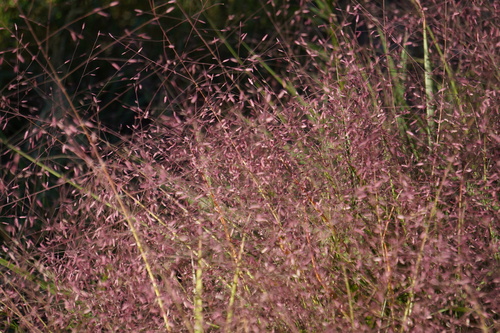
Purple Lovegrass
Eragrostis spectabilis
A shimmering magenta mist that dances in the late summer breeze, Purple Lovegrass is the 'hidden gem' of the native prairie. This hardy bunchgrass turns ordinary backyards into glowing purple landscapes during the golden hour.
Quick Identification
Size
Height: 1–2 feet (30–60 cm); Spread: 1.5–3 feet (45–90 cm)
Colors
Bright reddish-purple to magenta seed heads; blue-green foliage that turns bronze-brown in winter
Key Features
- Airy, cloud-like purple panicles (flower clusters)
- Low-growing, clumping bunchgrass habit
- Stiff, flat leaf blades with small hairs at the base
- Tumbleweed-style seed dispersal in late autumn
When You’ll See Them
Behavior
Purple Lovegrass is a warm-season perennial grass that remains a modest, low-profile clump of green for most of the early summer. However, as the intense heat of August and September arrives, it undergoes a dramatic transformation. It sends up hundreds of tiny, delicate branches that form a vibrant, misty cloud of magenta flowers just above the foliage, creating a stunning visual effect when planted in masses.
This species is a 'tumbleweed' grass. Once the seeds have fully ripened in late autumn, the entire airy flower head (the panicle) becomes brittle and snaps off at the base. These purple 'clouds' then roll across open fields and suburban lawns with the wind, dropping seeds as they go. It is a highly resilient plant, often found in the 'hellstrip' between sidewalks and roads because it is remarkably tolerant of drought, poor soil, and road salt.
EverydayEarth exclusive
Camera Tips
Capturing the beauty of Purple Lovegrass on a backyard camera requires a different strategy than tracking animals. Because the fine, hair-like stems of the grass move constantly in the slightest breeze, a standard PIR (Passive Infrared) motion sensor will likely be triggered non-stop, quickly draining your battery and filling your SD card. Instead, the best way to document this species is by using your camera’s Time-Lapse mode. Set the camera to take one photo every 30 minutes from sunrise to sunset to watch the purple 'haze' develop over several weeks in late summer.
For the most professional-looking shots, placement is everything. Position your camera at a very low 'worm’s-eye' angle—no more than 6 inches off the ground—aiming slightly upward. This perspective emphasizes the 'cloud' effect of the seed heads against the sky. To make the purple color truly pop, ensure the camera is facing toward the sun (backlighting). When the sun is low on the horizon, the light will catch the translucent purple stems, making the entire plant appear to glow from within.
If you are using a camera to monitor the wildlife that visits the grass, look for small butterflies like the Zabulon Skipper, which use Purple Lovegrass as a host plant for their caterpillars. In this case, use a camera with a 'Macro' or close-focus setting. During the late fall, keep your camera active to catch the dramatic moment the seed heads break off and tumble away. A high-shutter-speed setting is recommended if your camera allows it, as this will prevent the fine purple structures from appearing as a blurry smudge during windy conditions.
Similar Species
Species that look similar or are commonly confused with Purple Lovegrass.
Frequently Asked Questions
Record Purple Lovegrass at your habitat
Connect a camera to start building your own species record — AI identifies every visitor automatically.