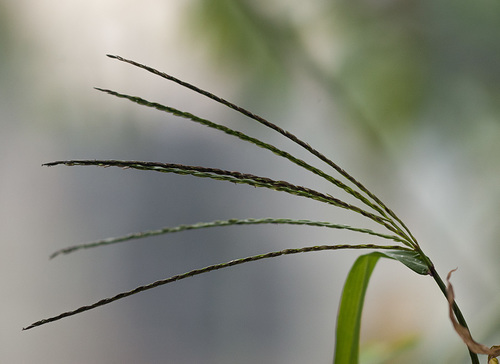
Hairy Crabgrass
Digitaria sanguinalis
Often dismissed as a common lawn weed, Hairy Crabgrass is a master of survival and a historical grain crop. Its finger-like seed heads and fuzzy texture make it a fascinating subject for backyard time-lapse photography.
Quick Identification
Size
Height: 15–90 cm (6–35 in); Spreads to 30–60 cm (12–24 in) wide
Colors
Pale green to lime green foliage; stems often transition to a distinct reddish-purple at the base
Key Features
- Finger-like flower spikes radiating from the stem top
- Distinctly hairy leaf sheaths and blades
- Prostrate growth habit that roots at the joints (nodes)
- Purple-tinted stems and seed heads in late summer
When You’ll See Them
Behavior
Hairy Crabgrass is a resilient annual plant known for its aggressive, opportunistic growth. It thrives in the peak heat of summer when many turf grasses begin to struggle or go dormant. As a 'pioneer species,' it is often the first to colonize bare or disturbed soil, using its creeping stems (stolons) to quickly claim territory. When the stems touch the ground, they can form new roots at each joint, allowing a single plant to form a dense, competitive mat.
While often viewed as a common lawn weed, Hairy Crabgrass has a fascinating lifecycle. It produces thousands of seeds per season, which can remain viable in the soil for several years. In its native range and in agricultural history, it has been valued as a high-protein fodder for livestock and even as a cultivated grain for human consumption, particularly in Eastern Europe where it was known as 'Polish millet.'
EverydayEarth exclusive
Camera Tips
Capturing the life cycle of Hairy Crabgrass requires a different approach than filming mobile wildlife. To get the best results with an AI-powered or trail camera, set your device to time-lapse mode rather than motion-trigger. Position the camera on a low-profile stake or a specialized ground mount only 4 to 6 inches off the surface. This 'worm's eye view' allows you to see the unique 'finger' spikes as they emerge and bloom, which is much more visually interesting than looking straight down from above.
For the most striking images, pay attention to the lighting. Hairy Crabgrass gets its name from the fine, silvery hairs on its leaves and sheaths. If you position your camera so the sun is behind the plant (backlighting), those tiny hairs will catch the light and glow, making the plant stand out against the background. Early morning is the best time for this, as dew drops often get trapped in these hairs, creating a beautiful crystalline effect that AI cameras can capture in high detail.
If you are using an AI camera to monitor lawn health or weed spread, place the camera at the edge of a suspected patch in early June. Set the interval to one photo every 4–6 hours. Over a month, you will see a fascinating 'crawl' as the plant roots at its nodes and expands its footprint. This is a great way to understand exactly how 'creeping' weeds take over a space. For settings, use a high-resolution still image mode and ensure the focus is locked on the foreground to prevent the camera from focusing on distant grass blades.
Similar Species
Species that look similar or are commonly confused with Hairy Crabgrass.
Frequently Asked Questions
Record Hairy Crabgrass at your habitat
Connect a camera to start building your own species record — AI identifies every visitor automatically.