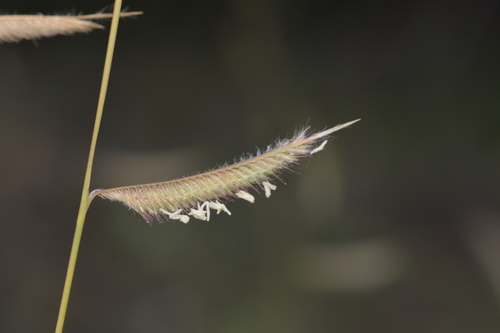
hairy grama
Bouteloua hirsuta
Often called 'eyebrow grass,' hairy grama is a tough-as-nails prairie native with a whimsical silhouette. Its distinctive comb-like seed heads provide essential winter forage for birds and a beautiful texture to any sunny backyard.
Quick Identification
Size
6–18 inches (15–45 cm) tall; 6–12 inches (15–30 cm) wide
Colors
Gray-green foliage; seed heads start green-purple and cure to a distinctive golden-tan or reddish-brown.
Key Features
- Comb-like seed heads resembling tiny 'eyebrows' or eyelashes
- Distinctive needle-like point extending beyond the flower clusters
- Small hairs (papilla-based) along the margins of the leaf blades
- Low-growing, clump-forming perennial bunchgrass habit
When You’ll See Them
Behavior
In the backyard ecosystem, it acts as a foundational support species. While it doesn't 'move' in the traditional sense, its seasonal behavior is a slow-motion display of survival. In mid-summer, it sends up slender stalks topped with its famous seed spikes, which curve gracefully as they dry. These spikes persist well into the winter, providing visual interest and structural cover for ground-dwelling insects and small mammals.
EverydayEarth exclusive
Camera Tips
Capturing the beauty of hairy grama with an AI-powered or trail camera requires a focus on micro-movements and seasonal transitions. Because this is a shortgrass, you should mount your camera very low—ideally no more than 6 to 10 inches off the ground. Use a ground spike or a weighted base to position the lens so it looks slightly upward at the seed heads. This perspective makes the 'eyebrow' spikes stand out dramatically against the sky or a distant background rather than getting lost in the soil and mulch.
For settings, if your camera supports a 'timelapse' or 'field scan' mode, this is the best way to document hairy grama. Set the camera to take a photo every 30 minutes during daylight hours over several weeks in late summer. This will capture the fascinating transition as the seed heads emerge, unfurl their purple-tinted flowers, and eventually curl into their iconic dried shape. If your camera is triggered by motion, be aware that high winds may cause 'false triggers'—however, these clips often capture the beautiful 'shiver' of the prairie that defines the species' presence in the landscape.
Lighting is your best friend when photographing this grass. Position your camera so that the grass is 'backlit' during the golden hours (shortly after sunrise or before sunset). The fine hairs on the stems and the delicate spikes of the seed heads catch the light and glow, making the plant pop from the background. This is also the best time to catch wildlife interactions; look for small birds like sparrows or finches landing on the stalks to forage for seeds, or pollinators visiting the tiny flowers during their brief bloom period in mid-summer.
If you are using a camera with macro capabilities or a close-focus lens, aim for the point where the leaf meets the stem. The 'hairy' part of the hairy grama is most visible here as tiny bumps (papillae) with hairs growing out of them. Capturing these fine details is the hallmark of a true naturalist's photo collection and helps distinguish this species from its close relatives like blue grama.
Similar Species
Species that look similar or are commonly confused with hairy grama.
Frequently Asked Questions
Record hairy grama at your habitat
Connect a camera to start building your own species record — AI identifies every visitor automatically.