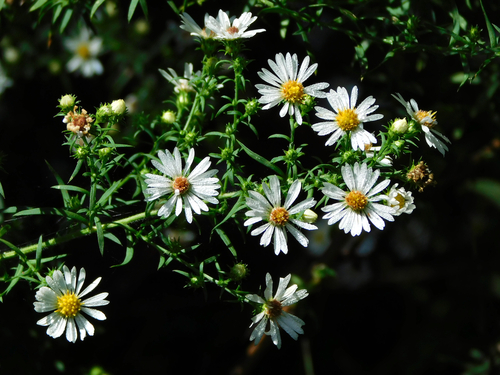
hairy white oldfield aster
Symphyotrichum pilosum
A late-season superstar, the hairy white oldfield aster transforms autumn landscapes into a sea of white blossoms. It is a vital sanctuary for pollinators, blooming well into the first frosts of the year.
Quick Identification
Size
Height ranges from 30–150 cm (1–5 feet), with a spread of 30–90 cm (1–3 feet).
Colors
Brilliant white ray flowers (petals) surrounding a central disc that starts yellow and matures to reddish-purple; stems are green to reddish-brown and covered in fine white hairs.
Key Features
- Distinctly hairy stems (var. pilosum)
- Small white daisy-like flowers, 0.5 to 1 inch wide
- Pointed, awl-shaped bracts at the base of flowers
- Prolific late-season blooming habit
When You’ll See Them
Behavior
The hairy white oldfield aster is a vigorous perennial known for its late-season burst of life. As other garden plants begin to fade in the cooling temperatures of autumn, this aster explodes into a cloud of white, providing a critical nectar source for migrating insects. It often forms large, shrub-like clumps that can lean or sprawl if not supported by surrounding vegetation.
While it is a stationary plant, it is an opportunistic grower, often colonizing disturbed soils, abandoned fields, and garden edges. It interacts with humans primarily as a 'volunteer' plant that many gardeners mistake for a weed until its spectacular flowering display begins in September. Its ability to tolerate drought and poor soil makes it a resilient and vital resident of the backyard ecosystem.
EverydayEarth exclusive
Camera Tips
Since the hairy white oldfield aster is a stationary target, the goal for your backyard camera is to capture the incredible diversity of wildlife it attracts. Position your camera on a tripod or mounting stake approximately 18 to 24 inches from a cluster of blooms. To capture the best action, angle the camera slightly downward to focus on the flower heads where pollinators land. High-definition video or burst photo modes are essential for freezing the motion of rapid visitors like hoverflies and bees.
Lighting is your best friend when photographing this species. Because the petals are bright white, they can easily 'blow out' and lose detail in direct, harsh midday sun. Set your camera to record during the 'golden hours'—shortly after sunrise or before sunset—to get a warm, soft glow that highlights the hairy texture of the stems and the intricate details of the yellow-to-purple centers. If your camera allows for exposure adjustment, slightly underexpose to keep those white petals crisp.
Don't just set it and forget it; use time-lapse mode to document the plant's transformation. Start recording in late August to capture the dramatic shift from green buds to a white floral explosion. This species is especially famous for attracting the final waves of migrating Monarch butterflies and industrious honeybees prepping for winter. For the best macro-style shots of these insects, ensure your camera's focal point is locked on the center of a prominent flower cluster.
Lastly, consider the weather. This plant is nicknamed the 'frost aster' because it can survive early frosts. Cameras with good weather sealing can capture rare, beautiful shots of the white flowers dusted with morning frost or ice crystals. Use a fast shutter speed if available to minimize blur caused by the wind, as these tall, airy stems tend to sway significantly in the autumn breeze.
Similar Species
Species that look similar or are commonly confused with hairy white oldfield aster.
Frequently Asked Questions
Record hairy white oldfield aster at your habitat
Connect a camera to start building your own species record — AI identifies every visitor automatically.