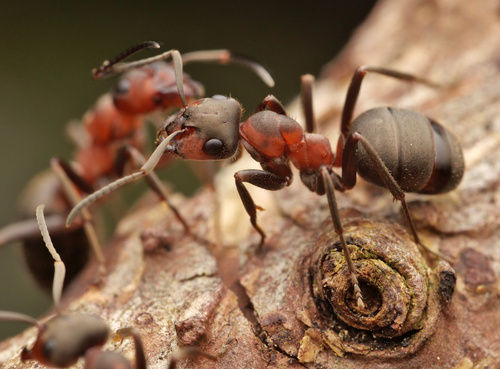
Hairy Wood Ant
Formica lugubris
Meet the upland forest's most industrious engineers. The Hairy Wood Ant builds sprawling thatched metropolises and defends them with incredible social coordination.
Quick Identification
Size
Workers range from 6 to 9 mm (0.24 to 0.35 inches); queens are larger, reaching up to 12 mm (0.47 inches).
Colors
Bicolored with a reddish-brown thorax (mid-section) and a dark brownish-black head and abdomen.
Key Features
- Microscopic fringe of hairs reaching down to the eyes
- Visible hairs between the facets of the compound eyes
- Massive thatched mound nests built from pine needles
- Reddish-brown midsection contrasting with a darker head and rear
When You’ll See Them
Behavior
The Hairy Wood Ant is a master architect of the forest floor, known for constructing massive, heat-trapping mounds out of pine needles, soil, and twigs. These social insects live in complex colonies that can house hundreds of thousands of individuals, often with multiple queens. Within the colony, workers are highly organized, spending their days foraging for food, maintaining the nest's internal temperature, and defending their territory with remarkable bravery.
They are famous for their symbiotic relationship with aphids, which they "farm" for sugary honeydew. In exchange for this sweet liquid, the ants protect the aphids from predators. When a mound is threatened, these ants don't just bite; they can stand on their hind legs and spray formic acid from their abdomens to deter intruders. While they are generally harmless to humans if left alone, they will swarm and defend their home vigorously if the nest is disturbed.
EverydayEarth exclusive
Camera Tips
Capturing the frantic world of the Hairy Wood Ant requires a specialized approach because of their small size and rapid movement. To get high-quality footage, position your camera on a mini-tripod or a stable rock just a few inches off the ground. Don't aim for the mound itself, which can look like a blurry mess; instead, find an "ant highway"—the clear paths they wear into the forest floor—and focus your camera on a specific bottleneck or a flat section of a log where they travel in lines.
If your camera supports macro photography or has a close-focusing distance, this is the perfect time to use it. To encourage the ants to pause for a clear shot, you can place a tiny drop of sugar water or honey on a textured leaf or a piece of bark within the camera's frame. This creates a natural-looking feeding station that allows the AI to capture clear frames of their distinctive hairy heads and reddish bodies. Be mindful of the light; dappled sunlight in a forest clearing provides the best detail without the harsh shadows of direct noon sun.
Be cautious about placing your camera too close to a large nest for long periods. These ants are highly territorial and may climb onto the device, potentially spraying it with formic acid, which can be corrosive to some plastics and lens coatings over time. For the best results, use a high frame rate or a fast shutter speed to freeze their movement. Early spring is a particularly rewarding time for filming, as the ants are extremely active while repairing their mounds after the winter snows melt.
Similar Species
Species that look similar or are commonly confused with Hairy Wood Ant.
Frequently Asked Questions
Record Hairy Wood Ant at your habitat
Connect a camera to start building your own species record — AI identifies every visitor automatically.