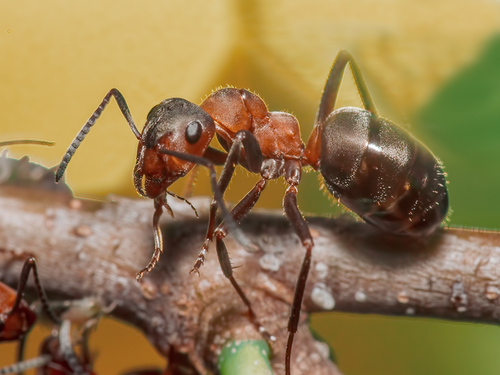
Southern Wood Ant
Formica rufa
Meet the forest's most industrious engineers: the Southern Wood Ant. Famous for their massive thatched mounds and organized social structure, these red-and-black architects are the powerhouse of the woodland floor.
Quick Identification
Size
Workers measure 4.5–9 mm (0.18–0.35 inches) in length; Queens are larger, up to 12 mm (0.47 inches).
Colors
Distinctive bi-colored body with a rusty-red head and thorax and a brownish-black abdomen (gaster).
Key Features
- Red and black bi-colored body
- Dome-shaped nests made of pine needles and twigs
- Ability to spray formic acid when threatened
- Large, powerful mandibles for carrying prey
When You’ll See Them
Behavior
Southern Wood Ants are highly social insects famous for building massive, thatched mound nests that can house hundreds of thousands of individuals. They are the 'architects of the forest,' creating complex networks of foraging trails that radiate from their mounds like highways. These ants are notoriously aggressive and territorial; if a nest is disturbed, workers will swarm out to bite the intruder and spray formic acid from their abdomens, creating a distinct vinegar-like scent in the air.
Within the colony, there is a strict division of labor. Older workers typically forage and defend the nest, while younger ants tend to the queen and the brood deep within the mound. They are incredibly industrious, often seen hauling prey or nesting materials many times their own body weight. Their presence is a sign of a healthy, mature ecosystem, as they help circulate nutrients and control pest populations.
EverydayEarth exclusive
Camera Tips
Capturing Southern Wood Ants on camera requires a different approach than larger wildlife. Because of their size, you will need a trail camera with a 'macro' or close-focus capability. If your camera has a fixed focus, try attaching a +1 or +2 close-up diopter lens over the casing. Position the camera on a small tripod or directly on the ground, just 6–12 inches away from an active foraging trail—the cleared 'highways' on the forest floor—rather than directly on the nest mound to avoid being swarmed and having your gear covered in formic acid.
Lighting is crucial for these insects. Since they are most active in the sun, look for spots where dappled sunlight hits a log or a flat stone along their path. This light will highlight the shiny texture of their carapaces and the vibrant red of their thoraces. Set your camera to a high-speed video mode (60fps or higher) or a fast burst photo mode; wood ants move surprisingly quickly, and a standard shutter speed may result in motion blur.
To create a focal point for your shots, place a small 'bait' like a spoonful of jam or sugar water on a flat rock within the camera's field of view. This will cause the ants to congregate and slow down, giving you much better opportunities for clear, detailed images. Be sure to check your camera frequently, as these ants are curious and may attempt to build over or under your equipment if it stays in one place too long during the peak summer months.
Similar Species
Species that look similar or are commonly confused with Southern Wood Ant.
Frequently Asked Questions
Record Southern Wood Ant at your habitat
Connect a camera to start building your own species record — AI identifies every visitor automatically.