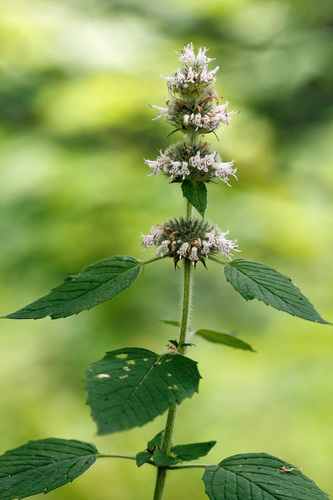
Hairy Wood Mint
Blephilia hirsuta
A woodland gem with a 'pagoda' of speckled flowers, Hairy Wood Mint is a stunning native perennial that turns any shaded corner into a bustling pollinator café.
Quick Identification
Size
Stands 1 to 3 feet tall (30 to 91 cm) with a spread of approximately 12 to 18 inches (30 to 45 cm).
Colors
Creamy white to pale lavender flowers with tiny purple speckles; foliage is a deep, hairy green.
Key Features
- Distinctly hairy, square-shaped stems
- Tiered flower clusters resembling a pagoda
- Ovate, opposite leaves with serrated edges
- Foliage releases a minty scent when crushed
When You’ll See Them
Behavior
Hairy Wood Mint is a clump-forming perennial that brings architectural interest to the forest floor. Unlike some of its more aggressive mint relatives, it tends to stay in localized patches, spreading slowly through a combination of rhizomes and seed dispersal. It is a vital component of the woodland ecosystem, serving as a primary nectar source for mid-summer insects when other forest blooms have faded.
During the day, the plant is a hub of social activity for the insect world. It attracts a wide variety of specialist bees, bee flies, and butterflies. Because the flowers are stacked in dense whorls, pollinators often spend significant time on a single plant, crawling from one 'story' of the pagoda to the next, which makes it an excellent subject for observation and photography.
EverydayEarth exclusive
Camera Tips
To capture the architectural beauty of Hairy Wood Mint, position your camera at a low angle, roughly 12 to 18 inches from the ground. This 'worm's-eye view' emphasizes the 'pagoda' structure of the flower tiers and allows the camera to capture the fine, silver hairs on the stem that give the plant its name. If you are using a macro lens or a high-resolution trail camera, aim for a side profile to highlight the purple spotting inside the individual tubular flowers.
Because Hairy Wood Mint is a pollinator magnet, setting your camera to 'Burst Mode' or high-speed video is essential. You will likely catch bumblebees, clearwing moths, and flower flies darting between the whorls. Since these plants thrive in dappled shade, lighting can be tricky; try to set up your camera during the morning hours when the light is soft and even, avoiding the harsh, high-contrast shadows of midday sun.
If you are using an AI-powered backyard camera, place the unit on a small tripod or garden stake directly facing a healthy cluster of blooms. Avoid using a flash if possible, as the reflective hairs on the plant can cause 'white-out' or overexposure in the image. Instead, rely on natural light to showcase the delicate lavender hues of the petals.
Consider setting up a time-lapse over a 48-hour period during the peak of July. This will allow you to see the individual flowers within the whorls opening from the bottom to the top. It also provides a fascinating look at the sheer volume of insect traffic a single native plant can support in a suburban environment.
Similar Species
Species that look similar or are commonly confused with Hairy Wood Mint.
Frequently Asked Questions
Record Hairy Wood Mint at your habitat
Connect a camera to start building your own species record — AI identifies every visitor automatically.