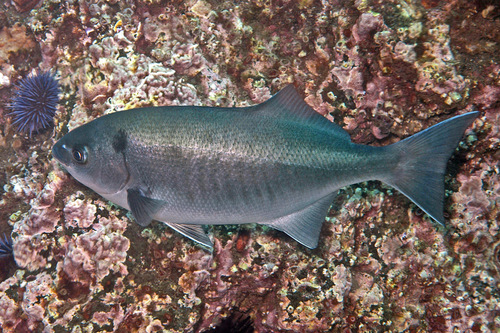
Halfmoon
Medialuna californiensis
With its shimmering blue scales and iconic crescent-shaped tail, the Halfmoon is the graceful acrobat of the Pacific kelp forests. A common sight for coastal residents, this social grazer brings vibrant life to rocky shorelines and piers alike.
Quick Identification
Size
Typically 12-19 inches (30-48 cm) in length and weighing up to 4 lbs (1.8 kg).
Colors
Deep blue to slate gray on the upper body, fading to a lighter silvery-blue or white on the belly; no prominent stripes or spots.
Key Features
- Distinctive half-moon or crescent-shaped tail fin
- Small, down-turned mouth suitable for grazing
- Dark blue-gray coloration with an iridescent sheen
- Soft-rayed portion of the dorsal fin is longer than the spiny section
- Light spot often visible behind the dorsal fin on the upper back
When You’ll See Them
Sightings on EverydayEarth
Jul 11, 2026
A vibrant underwater scene shows several fish navigating a kelp forest. A large male California Sheephead swims purposefully across the lower part of the frame, while a silvery Halfmoon glides closer to the camera in the upper water column. The kelp fronds sway rhythmically with the ocean current.
Jun 12, 2026
A Halfmoon fish swims through the kelp forest, passing very close to the lens before another view shows it gliding gracefully past the swaying amber kelp fronds.
Mar 30, 2026
A Halfmoon fish swims through the underwater kelp forest, navigating between the swaying amber fronds as sunlight filters down from the surface.
Mar 30, 2026
A Halfmoon fish swims through the kelp forest, twice approaching the camera lens for a close-up view. The amber kelp fronds sway steadily in the underwater current as light from the surface dances across the scene.
Mar 29, 2026
A large male California Sheephead swims through a dense forest of giant kelp, its bright orange-red midsection contrasting against the green-tinted water. Several smaller Halfmoons are visible in the background, darting between the kelp fronds as the entire underwater scene sways gently with the ocean current.
Mar 28, 2026
A vibrant orange Garibaldi swims through the amber kelp forest, crossing the frame from left to right. Later, a darker Halfmoon emerges from the kelp near the bottom of the frame, swimming steadily through the surge. The giant kelp blades sway continuously with the underwater currents.
Geographic range
Where Does the Halfmoon Live?
Native to the eastern Pacific Ocean, the Halfmoon is a quintessential inhabitant of the West Coast of North America. Its range begins in the cool waters off Vancouver Island, British Columbia, and extends southward to the Gulf of California in Mexico. They are most densely concentrated in the temperate waters of Southern California, particularly around the Channel Islands, where the blend of cold and warm currents supports massive kelp forests.
Basemap © OpenStreetMap contributors
Recorded on EverydayEarth
Behavior
The Halfmoon is a social and schooling fish that is a staple of the Pacific kelp forest ecosystem. Unlike many other species that hide deep within rocky crevices, Halfmoons are active swimmers that spend their days navigating the mid-water column and the edges of kelp canopies. They are diurnal, meaning they are most active during the daylight hours, and are known for their inquisitive nature, often approaching divers or snorkelers if they aren't moving too aggressively.
These fish exhibit a very stable social structure within their local reefs. They aren't particularly territorial but will congregate in large numbers where food is plentiful. In a suburban coastal context, they are frequently seen around man-made structures like pier pilings and breakwaters, where they graze on the diverse bio-growth that accumulates on the wood and stone. Their agility allows them to navigate the turbulent 'surge zone' where waves break against the shore, a habitat many other fish avoid.
EverydayEarth exclusive
Camera Tips
Capturing the Halfmoon on an AI-powered camera requires a waterproof setup, ideally positioned near a dock or a rocky shelf in a 'backyard' coastal area. For the best results, mount your camera at a depth of 3 to 10 feet where sunlight is still strong enough to illuminate their blue scales. Use a wide-angle lens to capture the schooling behavior, as these fish are rarely alone. Angle the camera slightly upward to catch the silhouette of their namesake half-moon tail against the brighter surface water.
To draw Halfmoons into the camera’s field of view, use a scent-based attractant. A mesh bag or a perforated PVC tube filled with crushed mussels or frozen shrimp works wonders. Secure this 'chum' about two feet in front of the lens. Because Halfmoons are grazers, they will spend significant time picking at the bait, giving your AI camera plenty of time to trigger and record clear, high-quality footage. In suburban marinas, placing the camera near pilings covered in barnacles and algae will naturally attract them without the need for additional bait.
Daylight is your best friend when filming this species. Between 10 AM and 2 PM, the sun is directly overhead, minimizing the 'flicker' effect caused by surface waves and maximizing the color accuracy of the fish's blue-gray body. If your camera has adjustable settings, use a fast shutter speed (at least 1/120) to prevent motion blur from their quick, darting movements. In late summer and fall, when water clarity is usually at its peak in California, you can capture stunningly crisp images of entire schools moving in unison.
Similar Species
Species that look similar or are commonly confused with Halfmoon.
Frequently Asked Questions
Record Halfmoon at your habitat
Connect a camera to start building your own species record — AI identifies every visitor automatically.