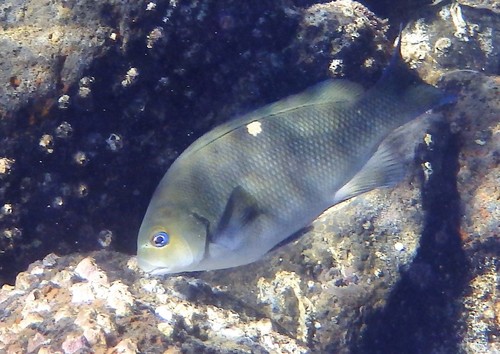
Opaleye
Girella nigricans
Boasting brilliant sapphire eyes and a calm, grazing nature, the Opaleye is the 'underwater goat' of the California coast. These hardy fish are a delight for tide-poolers and snorkelers alike, easily identified by the bright white spots on their dark, olive-green backs.
Quick Identification
Size
12-26 inches (30-66 cm); up to 13.5 lbs (6 kg)
Colors
Dark olive-green to charcoal grey body; two distinct white or cream-colored spots on the back; brilliant iridescent blue-green eyes
Key Features
- Striking iridescent blue or green eyes
- Two prominent white spots located below the dorsal fin
- Heavy, oval-shaped body with a blunt, rounded head
- Small mouth with comb-like teeth for grazing
When You’ll See Them
Sightings on EverydayEarth
Jul 24, 2026
Various species of temperate reef fish swim around submerged pier pilings covered in marine growth. A male California Sheephead, several Kelp Bass, and Opaleye are seen navigating the water column in the clear, sunlit marine environment.
Jul 23, 2026
A diverse array of marine life is active around the underwater pillars. A large, dark Opaleye with distinct white spots on its back swims in the foreground. Schools of slender Blacksmith Chromis dart through the water column. A bright orange Garibaldi passes through the background, and several Kelp Bass with mottled patterns are seen patrolling near the structural supports.
Jul 23, 2026
An Opaleye swims leisurely between the large, barnacle-encrusted pylons of a pier in the clear blue water of Big Fisherman Cove. The fish moves steadily across the frame while the surrounding water remains calm with high visibility.
Jul 22, 2026
In the clear blue waters of Big Fisherman Cove, a bright orange Garibaldi swims gracefully between barnacle-encrusted pier pilings. Several dark-colored Opaleye and schools of small Blacksmith are also visible, darting through the shifting patterns of sunlight filtering from the surface.
Jul 21, 2026
An active underwater scene shows a diverse array of fish swimming among large pier pylons. Several Opaleye are seen grazing and maneuvering near the mossy structures, while a Kelp Bass swims through the upper water column. A large school of small Blacksmith drifts in the background, moving together through the clear blue water.
Jul 20, 2026
A diverse community of reef fish is active around the encrusted pier pilings. A bright orange Garibaldi swims through the lower portion of the frame, while several larger Kelp Bass patrol the mid-water. Throughout the scene, schools of small, dark Blacksmith Chromis and stockier Opaleye drift between the columns in the clear, sunlit water.
Behavior
Socially, they are quite gregarious, especially when young. Juvenile Opaleyes are commonly found in tide pools where they act as 'cleaners,' sometimes nibbling on the skin of other fish. As they mature, they move into deeper water but remain closely tied to the kelp canopy. They are highly observant fish, and their large, bright eyes are constantly scanning for both predators and the best patches of succulent red and green algae.
EverydayEarth exclusive
Camera Tips
Lighting is your biggest challenge underwater. Try to film on bright, sunny days between 10 AM and 2 PM when the sun is directly overhead to penetrate the water column. If you are filming from a pier or dock above the water, a polarizing filter is an absolute necessity. It will cut the surface glare and allow your AI camera to lock onto the distinctive white spots on the Opaleye's back, which are often the only things visible from a top-down perspective.
While they are largely herbivorous, Opaleyes are notoriously curious. You can 'bait' an area for the camera by weighted-down a mesh bag of fresh kelp or even frozen peas, which are a secret weapon used by local anglers to attract them. Set your camera to a high frame rate (at least 60 fps) because their feeding strikes—where they nip at the algae and quickly twist away—happen in the blink of an eye. During the spring spawning season, look for more aggressive behavior and larger groups congregating around deeper rocky outcrops.
Similar Species
Species that look similar or are commonly confused with Opaleye.
Frequently Asked Questions
Record Opaleye at your habitat
Connect a camera to start building your own species record — AI identifies every visitor automatically.