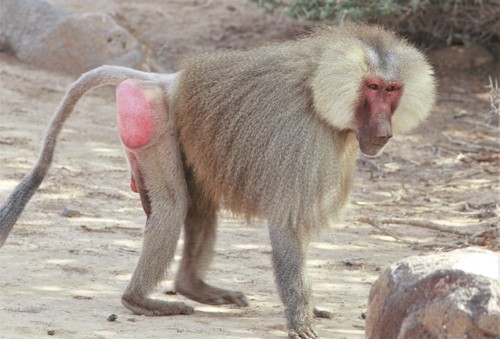
Hamadryas Baboon
Papio hamadryas
The 'Sacred Baboon' of ancient Egypt, known for its silver mane and complex desert dynasties. Discover the primate that bridges the gap between Africa and the Arabian Peninsula.
Quick Identification
Size
Males reach 60-95 cm (24-37 in) with a weight of 20-30 kg (44-66 lb); females are significantly smaller at 40-50 cm (16-20 in) and 10-15 kg (22-33 lb).
Colors
Males are silvery-gray with a massive mane and cape; females are olive-brown. Both sexes have hairless, pink or bright red faces and rumps.
Key Features
- Large silvery-white mane and cape on adult males
- Dog-like elongated muzzle
- Bright pink or red hairless seat pads (ischial callosities)
- Marked sexual dimorphism with males twice the size of females
When You’ll See Them
Geographic range
Where Does the Hamadryas Baboon Live?
Native to the Horn of Africa and the southwestern Arabian Peninsula, the Hamadryas Baboon is the only baboon species found outside of the African continent. Its core range spans across Ethiopia, Eritrea, Djibouti, and Somalia, extending across the Red Sea into the rugged highlands of Saudi Arabia and Yemen. While they prefer arid wilderness, they are increasingly spotted in suburban fringes and near mountain resorts where they successfully scavenge near human settlements.
Basemap © OpenStreetMap contributors
Behavior
The Hamadryas Baboon is famous for its complex, multi-layered social structure. At the smallest level is the 'one-male unit' (OMU), consisting of a single alpha male and several females. These units combine to form clans, which then join into bands, and finally massive troops that can number up to 400 individuals. This social system is unique among baboons and involves strict patrolling by males to keep their harems together.
These primates are strictly diurnal, spending their days foraging on the ground and moving across rocky terrain. They are highly communicative, using a vast array of facial expressions, vocalizations, and grooming rituals to maintain social bonds. While generally wary of humans in the wild, populations near urban areas in the Arabian Peninsula have become remarkably bold, often entering suburban outskirts in search of easy food sources.
EverydayEarth exclusive
Camera Tips
Capturing Hamadryas Baboons requires a strategy that accounts for their massive troop sizes and terrestrial habits. If you are near rocky escarpments or arid outskirts, place your camera at knee-height (about 50-60 cm) to capture the best eye-level portraits of both the towering males and the smaller females. Because they travel in large groups, use a wide-angle lens setting if available to avoid missing the social interactions happening at the edges of the frame.
Focus your efforts on transit corridors—natural paths leading from high sleeping cliffs down to valley floors or water sources. These baboons are most active shortly after sunrise as they descend to forage and again in the late afternoon. If you are using a trail camera in a suburban setting where they are known scavengers, ensure the camera is securely housed in a protective security box. These primates are highly intelligent and incredibly strong; they have been known to manipulate, bite, and even dismantle unsecured equipment out of curiosity.
For the best action shots, set your camera to 'Burst Mode' or 'Photo + Video.' The social dynamics of a troop are fast-paced; a single photo rarely captures the complexity of a male herding his OMU or juveniles wrestling. Avoid using heavy food lures in residential areas to prevent habituation, but a reliable water source in an arid environment will almost certainly attract a troop during the heat of the day. Check your lenses frequently, as the dusty environments they inhabit can quickly coat the glass, resulting in hazy images.
Similar Species
Species that look similar or are commonly confused with Hamadryas Baboon.
Frequently Asked Questions
Record Hamadryas Baboon at your habitat
Connect a camera to start building your own species record — AI identifies every visitor automatically.