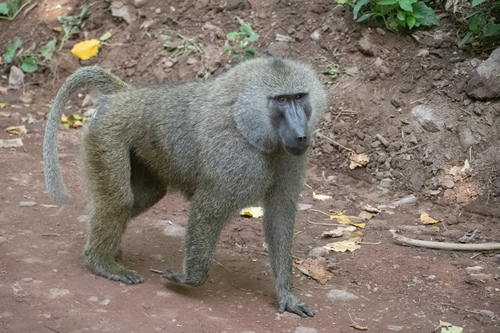
Olive Baboon
Papio anubis
The Olive Baboon is a master of adaptation, thriving across the diverse landscapes of Africa with its keen intelligence and powerful social bonds. Recognized by its grizzled green-grey coat and dog-like snout, this charismatic primate offers a fascinating window into the complexities of troop life.
Quick Identification
Size
Body length 60-85 cm (24-33 in); Weight 10-37 kg (22-82 lbs); Males are significantly larger and heavier than females.
Colors
Greenish-grey or olive-colored coat with a grizzled appearance; dark grey to black hairless face and rump.
Key Features
- Elongated, dog-like muzzle with powerful jaws
- Distinctive tail carriage that looks 'broken,' arching up and then hanging down
- Large, robust body with a thick mane of hair around the neck and shoulders in males
- Calloused ischial callosities (sitting pads) on the rump.
When You’ll See Them
Sightings on EverydayEarth
Jun 29, 2026
A troop of baboons is gathered in the branches of an acacia tree at dawn. Several individuals are visible as dark silhouettes against the overcast sky, with one near the top left shifting its position and turning its head. Loud, rhythmic grunting calls are audible as the troop begins to wake.
Jun 29, 2026
A troop of Olive Baboons is seen resting and waking up in the upper branches of a large tree. Several individuals are visible at various heights, shifting their weight and looking around as the wind blows through the canopy.
Jun 29, 2026
A troop of Olive Baboons is perched high in the canopy of an acacia tree. At least half a dozen individuals are visible, resting and scanning the surrounding woodland under an overcast sky. Some monkeys shift their positions on the branches, while others remain still, surveying the landscape from their elevated vantage point.
Jun 29, 2026
A troop of Olive Baboons is perched high in the branches of an acacia tree. Several individuals are visible as dark silhouettes against the bright sky, seen shifting positions, grooming themselves, and looking out over the landscape.
Jun 29, 2026
A troop of Olive Baboons is clustered in the upper branches of a tree during the low light of dawn or dusk. Several individuals are perched high up, while a pair on the right side of the canopy is actively engaged in social grooming, a key social bonding behavior.
Jun 21, 2026
A troop of Olive Baboons is active on the far bank of the watering hole. Several individuals can be seen bounding across the upper ridge from right to left, while others move through the scrub on the left side of the scene. The water remains calm with several large rocks or logs visible in the center, and the foreground vegetation sways gently in the wind.
Behavior
Olive Baboons are highly social and intelligent primates that live in complex groups called troops, which can range from a few dozen to over a hundred individuals. These troops are organized around a strict multi-male, multi-female hierarchy where social grooming plays a vital role in maintaining bonds and reducing tension. Watching them on camera often reveals a flurry of activity, from playful juveniles wrestling to high-ranking adults asserting their dominance through subtle vocalizations and facial expressions.
As opportunistic generalists, their daily life revolves around a structured routine of foraging, traveling, and socializing. They are primarily terrestrial, spending most of their daylight hours on the ground, but they are excellent climbers and will retreat to tall trees or cliff faces at night to sleep safely away from predators like leopards. In areas near human settlements, they have become remarkably bold, often using their problem-solving skills to navigate fences or even enter buildings in search of food.
EverydayEarth exclusive
Camera Tips
When setting up a camera for Olive Baboons, stability is your first priority. These primates are incredibly curious and physically powerful; if they spot a camera, they are likely to investigate, shake, or even try to dismantle it. Use a heavy-duty security housing or a steel cable lock, and mount the camera at a height of about 3 to 4 feet. Angling the camera slightly downward from a sturdy tree trunk will help capture their facial expressions and social interactions on the ground while keeping the unit somewhat out of their direct line of sight.
Because baboons move in large troops, a single photo is rarely enough to tell the whole story. Set your camera to 'Burst Mode' or 'Photo + Video' with a very short trigger interval. This ensures that after the lead male passes by, you continue to capture the females, juveniles, and infants that follow. A fast trigger speed (0.3 seconds or less) is essential, as baboons can move surprisingly quickly when they are traveling between foraging spots or chasing one another.
To attract them to a specific spot without causing conflict, look for natural 'funnels' in the landscape, such as gaps in rocky outcrops or well-worn paths leading to a water hole. While it might be tempting to use food bait, this is discouraged as it can lead to aggressive behavior and habituation to humans. Instead, focus your efforts near fruiting trees or areas with soft earth where they might dig for tubers. During the dry season, placement near a permanent water source is almost guaranteed to yield results as the whole troop will visit to drink and rest during the heat of the day.
Similar Species
Species that look similar or are commonly confused with Olive Baboon.
Yellow Baboon
Lighter, more slender build with a yellowish coat and a less prominent muzzle than the Olive Baboon.
Chacma Baboon
Generally larger and darker with a more elongated face and a distinctively downward-sloping back.
Hamadryas Baboon
Males have a spectacular silver-white cape or mane and bright pink faces, looking very different from the more uniform Olive Baboon.
Frequently Asked Questions
Record Olive Baboon at your habitat
Connect a camera to start building your own species record — AI identifies every visitor automatically.