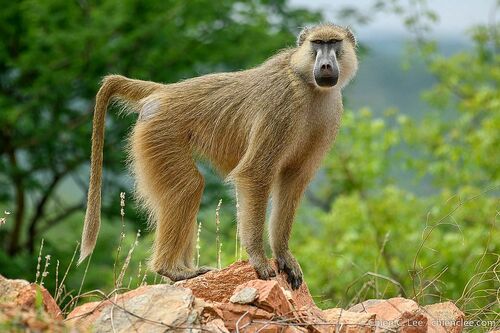
Yellow Baboon
Papio cynocephalus
With their golden coats and expressive, dog-like faces, Yellow Baboons are the charismatic socialites of the African savanna. Watching a troop on camera reveals a window into a world of complex politics, playful juveniles, and remarkable survival instincts.
Quick Identification
Size
Males measure up to 84 cm (33 in) and weigh 23–30 kg (51–66 lbs); females are smaller at 60 cm (24 in) and 11–15 kg (24–33 lbs).
Colors
Golden-yellow or yellowish-brown fur with a black, hairless face and white sideburns; infants are born with black fur that transitions as they age.
Key Features
- Slender build with long, lanky limbs
- Dog-like muzzle with a hairless black face
- Distinctive 'kinked' tail that stands up before arching down
- White sideburns framing the face
When You’ll See Them
Behavior
Yellow Baboons are highly social primates that live in complex multi-male, multi-female troops ranging from 20 to over 100 individuals. Their social structure is defined by a strict hierarchy where grooming plays a vital role in maintaining alliances and reducing tension within the group. You’ll often see them spending their mornings socializing and foraging together on the ground, though they are excellent climbers and retreat to the safety of tall trees or cliffs at night to sleep away from predators like leopards.
These monkeys are incredibly intelligent and adaptable. In areas where their habitat overlaps with human settlements, they quickly learn to exploit human food sources, sometimes becoming quite bold. While they are fascinating to watch, they are opportunistic foragers and can be quite vocal, using a variety of barks, screams, and facial expressions to communicate everything from a predator warning to a social spat over a piece of fruit.
EverydayEarth exclusive
Camera Tips
When setting up a camera for Yellow Baboons, height is your most important variable. Because these primates are primarily terrestrial during the day but arboreal at night, you have two great options. For social interactions and feeding behavior, mount your camera about 3 feet (1 meter) off the ground on a sturdy trunk. If you are looking for 'transit' shots or grooming sessions, look for large, flat-topped acacia trees or horizontal branches where they rest, and mount the camera higher up with a downward tilt.
Yellow Baboons are highly curious and possess excellent eyesight. They are likely to notice a new camera in their environment. To avoid them messing with the equipment—as they have dexterous hands and a penchant for dismantling shiny objects—use a lockable security box or 'bear box' and ensure the camera is well-camouflaged. Avoid using visible 'glow' infrared LEDs if possible, as the faint red light can sometimes attract their attention at dusk or dawn; a 'no-glow' black flash is much more effective for capturing candid nighttime behavior without spooking or attracting the troop.
Because baboons move in large groups, a standard 3-shot burst or a 20-second video clip is far better than a single photo. A single photo might only catch the alpha male at the front, while a longer video will capture the playful antics of the juveniles and the mothers carrying infants. If your camera has a 'Time Lapse' mode, consider using it near water holes or popular foraging clearings during the peak morning hours to see the entire troop move through the frame. Avoid using food as bait near residential areas, as this encourages 'problem' behavior; instead, focus on natural travel funnels like gaps in fences or well-worn paths leading to water.
Similar Species
Species that look similar or are commonly confused with Yellow Baboon.
Chacma Baboon
Larger and heavier with a much darker, brownish-gray coat and a longer, more elongated muzzle.
Olive Baboon
Has a distinct greenish-grey 'olive' tint to its fur and a heavier, more square-set build.
Vervet Monkey
Significantly smaller with a blue scrotum in males and a greyish-silver coat with a black face and white brow band.
Frequently Asked Questions
Record Yellow Baboon at your habitat
Connect a camera to start building your own species record — AI identifies every visitor automatically.