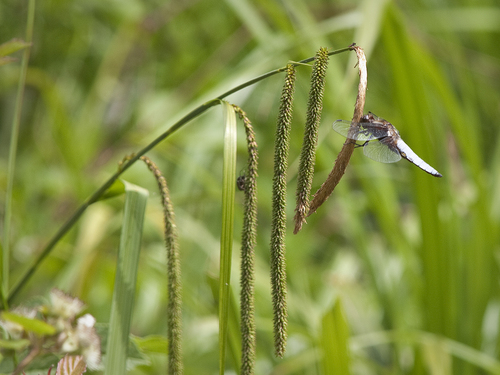
Hanging sedge
Carex pendula
The Hanging Sedge is a dramatic, arching perennial that brings a touch of wild woodland elegance to damp garden corners. Known for its massive evergreen clumps and signature weeping flower spikes, it is as much a sculpture as it is a plant.
Quick Identification
Size
Height: 1.5–2.5 meters (5–8 feet); Spread: 1.2 meters (4 feet)
Colors
Bright green to lime-green foliage; dark brown or yellowish-green pendulous flower spikes; glaucous (bluish-grey) leaf undersides
Key Features
- Distinctive drooping flower spikes up to 16cm long
- Stiff, sharply triangular stems
- Large, dense arching clumps of evergreen leaves
- V-shaped leaf cross-section with a prominent midrib
When You’ll See Them
Behavior
Hanging Sedge is an architectural powerhouse in the plant world, known for its dramatic, weeping form. Unlike many smaller grasses, it creates massive, evergreen clumps that remain vibrant even in the depths of winter. It is a prolific self-seeder, often described as 'thuggish' in smaller garden spaces because its heavy seed heads bend to the ground, effectively sowing next year's crop exactly where they land.
In the wild, it serves as a vital structural component of damp woodlands and stream banks. While it doesn't 'behave' in the animal sense, its presence dictates the local ecosystem; the dense foliage provides excellent overwintering cover for amphibians like frogs and newts, while the seeds provide a modest food source for small finches and woodland rodents.
EverydayEarth exclusive
Camera Tips
When setting up an AI camera to capture Hanging Sedge, the biggest challenge is motion. Because the flower spikes are so long and pendulous, even a slight breeze causes them to sway dramatically. If your camera uses PIR (Passive Infrared) motion detection, the plant itself won't trigger it, but if you are using pixel-change detection, you'll want to mask out the sedge or lower the sensitivity to avoid hundreds of false triggers on windy days. However, this movement is exactly what makes for beautiful time-lapse footage.
For the most striking images, place your camera at a low angle (about 1–2 feet off the ground) pointing slightly upward. This perspective emphasizes the 'hanging' nature of the spikes against the sky or canopy. If you are tracking the growth of the plant, place the camera at least 6 feet away; this sedge grows rapidly in spring and can easily overwhelm the frame, turning a clear view into a wall of green in just a few weeks.
Lighting is crucial for capturing the texture of the leaves. Position your camera so it is side-lit during the morning or evening hours. This 'golden hour' light catches the serrated edges of the leaves and the intricate textures of the male and female flowers within the drooping catkins. If your camera is placed in a deep woodland setting, ensure the 'Night Vision' or IR settings are tuned well, as the dense clumps can create very dark shadows that lose all detail.
Finally, consider the seasonal transition. Use your trail camera to capture the emergence of the flower spikes in late spring. By locking your camera in a fixed position (using a permanent post rather than a tree strap which might slip), you can create a fascinating seasonal record of how the spikes lengthen, turn from green to brown, and eventually dip to the soil under the weight of the seeds.
Similar Species
Species that look similar or are commonly confused with Hanging sedge.
Frequently Asked Questions
Record Hanging sedge at your habitat
Connect a camera to start building your own species record — AI identifies every visitor automatically.