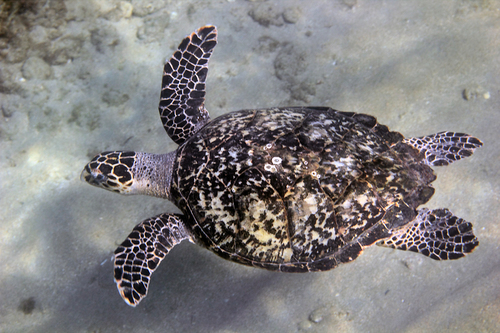
Hawksbill Sea Turtle
Eretmochelys imbricata
With its stunning 'tortoiseshell' pattern and a beak like a bird of prey, the Hawksbill is the most beautiful—and most endangered—of our sea turtles. This reef-dwelling wanderer is a vital guardian of coral health, keeping sponge populations in check across the world's tropical oceans.
Quick Identification
Size
Carapace length of 60–100 cm (2–3.3 ft); weight typically ranges from 45–70 kg (100–150 lbs)
Colors
Amber-colored carapace with beautiful streaks of brown and black; creamy yellow plastron (underside); head and flippers have dark scales with pale borders
Key Features
- Distinctive hawk-like curved beak
- Overlapping shell scutes with a serrated trailing edge
- Two visible claws on each flipper
- Four prefrontal scales located between the eyes
When You’ll See Them
Geographic range
Where Does the Hawksbill Sea Turtle Live?
Native to the tropical and subtropical waters of the Atlantic, Pacific, and Indian Oceans, the Hawksbill Sea Turtle is a true global citizen of the tropics. Its core range includes the warm waters of the Caribbean Sea, the Gulf of Mexico, Southeast Asia, and northern Australia, with significant nesting populations found in places like Mexico, the Seychelles, and Indonesia. While they are occasionally spotted in temperate regions during warm summers, they are most at home in the stable, warm temperatures of the equatorial belt.
Basemap © OpenStreetMap contributors
Behavior
The Hawksbill Sea Turtle is a largely solitary creature that spends the majority of its life in the vibrant, shallow waters of coral reefs and lagoons. Unlike some sea turtles that migrate across entire oceans in a straight line, Hawksbills tend to be more localized, often returning to the same reef 'home' for years. They are renowned for their specialized diet, using their narrow, pointed beaks to reach deep into reef crevices to pull out sponges—a food source that is toxic or indigestible to most other marine animals.
These turtles are generally shy around humans and will gracefully swim away if approached too quickly. However, they are creatures of habit; during the nesting season, females exhibit remarkable site fidelity, returning to the same sandy beaches where they were born to lay their eggs. Because they are often found in shallower water than other sea turtles, they are frequently encountered by snorkelers and coastal residents in tropical regions.
EverydayEarth exclusive
Camera Tips
For coastal residents lucky enough to have 'backyard' access to nesting beaches, capturing a Hawksbill on camera requires a specialized approach. If you are monitoring a known nesting beach, place your camera at a low angle (about 12–18 inches off the ground) near the high-tide line or the edge of the dune vegetation where turtles prefer to nest. Because Hawksbills nest at night, ensure your camera has a 'no-glow' or 'low-glow' infrared flash; white light or standard flashes can disorient the mother and prevent her from laying her eggs.
If you are using an underwater housing for a trail camera near a private dock or reef, secure the camera to a stable structure like a pier piling or a weighted base. Aim the camera toward a known 'sponge garden' or a specific reef crevice that shows signs of grazing. Since water clarity is key, try to position the camera so the sun is behind it during peak daylight hours to minimize glare and backlighting.
To capture the best footage, set your camera to take short video clips (15–30 seconds) rather than still photos. Sea turtles move with a slow, rhythmic grace that is best appreciated in motion. High-trigger sensitivity is recommended as their movement underwater can be fluid and may not always trigger a slow PIR sensor. Avoid using any chemical lures or baits, as these are ineffective for turtles and can harm the delicate reef ecosystem.
Similar Species
Species that look similar or are commonly confused with Hawksbill Sea Turtle.
Frequently Asked Questions
Record Hawksbill Sea Turtle at your habitat
Connect a camera to start building your own species record — AI identifies every visitor automatically.