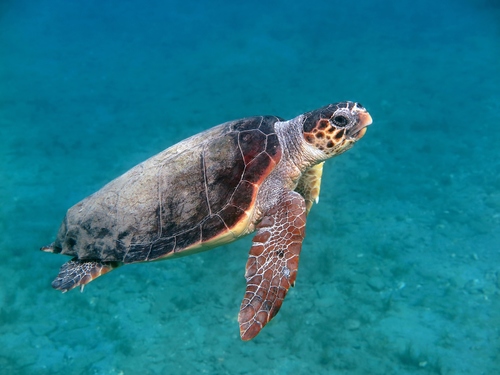
Loggerhead Sea Turtle
Caretta caretta
Ancient mariners of the deep, Loggerhead Sea Turtles are famous for their massive heads and thousand-mile migrations. These resilient reptiles connect our shores to the vast mysteries of the open ocean.
Quick Identification
Size
Carapace length 90 cm (35 in) on average; weight ranges from 135 kg (298 lb) to 200 kg (440 lb)
Colors
Heart-shaped reddish-brown carapace; skin varies from pale yellow to tan; plastron (underbelly) is creamy yellow
Key Features
- Large, disproportionately blocky head with powerful jaws
- Five pairs of costal scutes on the carapace
- Reddish-brown shell with a non-serrated back margin
- Adult males have much longer tails than females
When You’ll See Them
Geographic range
Where Does the Loggerhead Sea Turtle Live?
The Loggerhead Sea Turtle is a global ocean wanderer, native to the temperate, subtropical, and tropical waters of the Atlantic, Pacific, and Indian Oceans. In the Western Hemisphere, they are most concentrated along the southeastern coast of the United States, particularly Florida and the Carolinas, which host some of the world's densest nesting populations. They are also frequently found in the Mediterranean Sea, with significant breeding colonies along the coasts of Greece, Turkey, and Oman.
Basemap © OpenStreetMap contributors
Behavior
Loggerhead Sea Turtles are solitary, long-lived marine reptiles known for their incredible migratory journeys that can span entire ocean basins. While they spend the vast majority of their lives at sea, they are most famously observed by humans when adult females return to the very same sandy beaches where they were hatched to lay their own eggs. They are slow-moving on land but exceptionally graceful in the water, capable of diving for long periods to forage along the ocean floor.
These turtles are generally non-aggressive toward humans, but they are highly sensitive to disturbances during their nesting periods. They rely on celestial cues and the Earth's magnetic field for navigation. In coastal communities, their behavior is significantly influenced by human activity; artificial lighting can disorient hatchlings, leading them away from the ocean, which has led to widespread 'dark sky' initiatives in beachfront neighborhoods.
EverydayEarth exclusive
Camera Tips
Capturing a Loggerhead Sea Turtle on camera requires a specialized approach because they are strictly marine and only emerge on beaches under specific conditions. If you live on a beachfront property, the best placement for an AI-powered camera is at the edge of the dune line, angled toward the high-tide mark. Ensure the camera is mounted low—about 2 to 3 feet off the ground—to capture the turtle's profile as it crawls. Since nesting occurs almost exclusively at night, a camera with high-quality infrared or 'no-glow' LEDs is essential. Standard white flashes must never be used, as bright lights will scare off nesting females and lethally disorient hatchlings.
Because sea turtles are protected by law, never place a camera in a way that requires you to trek through protected dune grass or disturb a known nest. Check your local regulations regarding beach cameras, as many conservation zones have strict rules about equipment on the sand. The best time to set your camera is during the summer months when nesting activity peaks. Look for 'crawls'—distinctive tracks in the sand that look like giant tractor tires—and position your camera nearby to catch the next visitor.
Settings should be adjusted for high sensitivity and long video triggers. A 30-second video clip is better than a still photo, as it captures the slow, rhythmic movement of the turtle as it clears a pit for its eggs. If your camera allows for schedule settings, program it to be active only from dusk until dawn to save battery life and storage space, as you are unlikely to see a Loggerhead on the beach during the heat of the day.
Similar Species
Species that look similar or are commonly confused with Loggerhead Sea Turtle.
Green Sea Turtle
Smaller head and only four pairs of costal scutes on the shell compared to the Loggerhead's five.
Kemp's Ridley Sea Turtle
Much smaller overall and has a more circular, olive-grey shell rather than heart-shaped and reddish-brown.
Hawksbill Sea Turtle
Features a hawk-like beak and a shell with overlapping (imbricated) scutes that create a serrated edge.
Frequently Asked Questions
Record Loggerhead Sea Turtle at your habitat
Connect a camera to start building your own species record — AI identifies every visitor automatically.