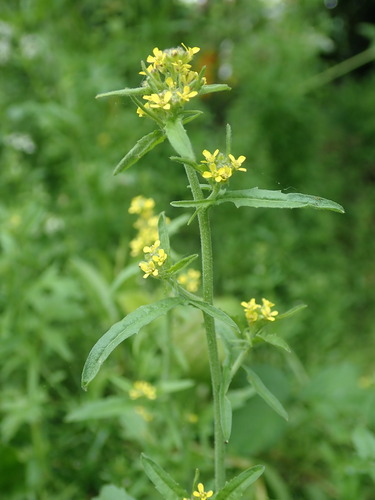
Hedge mustard
Sisymbrium officinale
Often called the 'Singer's Plant,' Hedge mustard is a master of survival in the backyard. Its wiry, skeletal frame and tiny yellow blossoms provide a hidden sanctuary for small pollinators and local songbirds.
Quick Identification
Size
Stands 30–90 cm (12–35 inches) tall; spreads roughly 15–30 cm (6–12 inches) at the base.
Colors
Small, pale yellow flowers; deep green to grayish-green foliage; stems often take on a purplish hue as they age.
Key Features
- Tiny four-petaled yellow flowers clustered at stem tips
- Seed pods (siliques) pressed tightly parallel to the stem
- Stiff, wiry branches that grow at nearly right angles from the main stalk
- Deeply lobed basal leaves that look similar to dandelion leaves
When You’ll See Them
Behavior
Hedge mustard is a resilient annual or biennial plant known for its distinctive, stiff branching structure that can look almost skeletal in late summer. While often dismissed as a common weed, it plays a vital role in suburban ecosystems by providing an early and mid-summer nectar source for a variety of small pollinators. It is particularly famous in folklore as the 'Singer's Plant,' as it was historically used in infusions to treat sore throats and loss of voice.
In a backyard setting, Hedge mustard is a pioneer species, often being the first to colonize patches of bare or disturbed earth. It grows rapidly, sending up a tall, central stalk before branching out horizontally. Unlike many other mustards that have spreading seed pods, this species keeps its pods 'tucked in' close to the stem, which is a key behavioral trait for identification. It is highly adaptable and can survive in poor soil, making it a frequent visitor to gravel paths and garden edges.
EverydayEarth exclusive
Camera Tips
Capturing Hedge mustard effectively requires a shift in how you use your backyard camera. Because it is a plant, a standard motion-trigger setup meant for mammals might miss the action. Instead, switch your AI camera to time-lapse mode. Set the camera to take a frame every 15 to 30 minutes over a week-long period in late spring. This will allow you to watch the 'stiff-branching' architecture develop, which is one of the most fascinating botanical growth patterns to observe in high speed.
To capture the wildlife that Hedge mustard attracts, position your camera about 12 to 18 inches away from the yellow flower clusters. Use a tripod or a garden stake to keep the camera steady at 'flower height.' Since the flowers are small (only 2-4mm), ensure your camera's focus is locked on the blooms. This setup is perfect for filming hoverflies, small bees, and even the occasional Cabbage White butterfly, which frequently visits the plant for nectar.
Lighting is crucial for this species because of its thin, wiry stems. Try to position your camera so the plant is backlit by the morning sun; this will highlight the tiny hairs on the stems and make the pale yellow flowers pop against the background. If you are using a trail camera for security or wildlife monitoring, look for Hedge mustard growing near fences or gates. Its stiff stalks often provide a perfect natural 'perch' for small songbirds like goldfinches, who may land on the plant to investigate the area.
In the autumn, don't move your camera just because the flowers are gone. The dried skeletal remains of Hedge mustard are excellent subjects for frost photography. If you have a macro lens or a high-definition AI camera, the seed pods pressed against the stem look architectural and striking when covered in morning dew or rime frost. This is a great way to document the full lifecycle of a backyard 'weed' that most people ignore.
Similar Species
Species that look similar or are commonly confused with Hedge mustard.
Frequently Asked Questions
Record Hedge mustard at your habitat
Connect a camera to start building your own species record — AI identifies every visitor automatically.