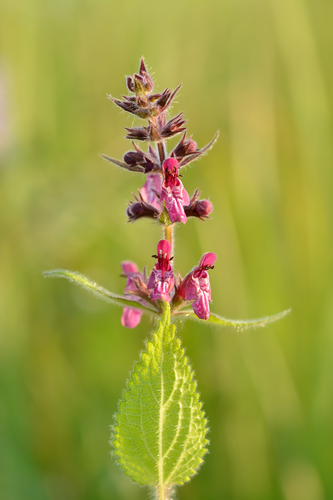
hedge woundwort
Stachys sylvatica
With its striking spikes of royal purple flowers and heart-shaped leaves, the hedge woundwort is a hidden gem of the woodland edge. Often mistaken for a nettle, this 'stinging-less' beauty is a magnet for bumblebees and a hardy addition to any wildlife-friendly backyard.
Quick Identification
Size
Stems reach 40–80 cm (16–31 in) in height; individual flowers are 12–18 mm (0.5–0.7 in) long.
Colors
Deep reddish-purple or maroon flowers with intricate white 'landing strip' markings on the lower lip; dark green foliage.
Key Features
- Square-shaped hairy stems
- Heart-shaped, serrated leaves arranged in opposite pairs
- Spikes of 6-10 purple flowers arranged in whorls
- Pungent, unpleasant smell when the leaves are crushed
When You’ll See Them
Behavior
During its blooming phase in mid-to-late summer, the plant becomes a central hub of activity. It has a specialized relationship with long-tongued bees, particularly the garden bumblebee, which are among the few insects capable of reaching the nectar hidden deep within the tubular flowers. While humans might find the plant's 'fetid' scent off-putting when weeding, this chemical defense helps protect the plant from grazing mammals, ensuring it survives to go to seed.
EverydayEarth exclusive
Camera Tips
Capturing the hedge woundwort on a trail camera requires a different strategy than mobile wildlife. Because this plant thrives in dappled shade, lighting is your biggest challenge. Position your camera at a low 'frog’s eye' view—about 12 inches from the ground—aiming slightly upward at a cluster of flower spikes. This perspective highlights the architectural beauty of the plant and helps separate the dark purple flowers from the dark green background foliage. If your camera has adjustable exposure, dial it up slightly to capture the fine white details on the petals without them being lost in the shadows.
The real magic happens when you use the hedge woundwort as a 'set' for insect photography. Use a high-trigger-speed setting or high-frame-rate video to capture the rapid visits of the Wool Carder Bee. These bees are highly territorial over woundwort patches and will chase off other insects. By focusing your camera on a single spike of flowers during a sunny afternoon in July, you are almost guaranteed to capture fascinating territorial displays and pollination behaviors that happen too fast for the naked eye to see.
For those interested in the plant's growth, a time-lapse setting is highly effective. Set your camera to take one photo every 2-3 hours over the course of a week in late June. When played back, you’ll see the 'woundwort crawl' as the flower spike elongates and the individual florets bloom sequentially from the bottom to the top. To avoid a 'jittery' video, ensure your tripod is weighted down or the camera is strapped tightly to a post, as these plants often grow in soft, damp soil that can shift.
Finally, consider the moisture factor. Hedge woundwort is most photogenic just after a summer rain shower or during a heavy morning dew. The tiny hairs on the stems and leaves trap water droplets, which can create a beautiful 'halo' effect when caught by the sun. Set your camera to trigger in the early morning (6-8 AM) to catch these shimmering textures before the sun dries them out.
Similar Species
Species that look similar or are commonly confused with hedge woundwort.
Frequently Asked Questions
Record hedge woundwort at your habitat
Connect a camera to start building your own species record — AI identifies every visitor automatically.