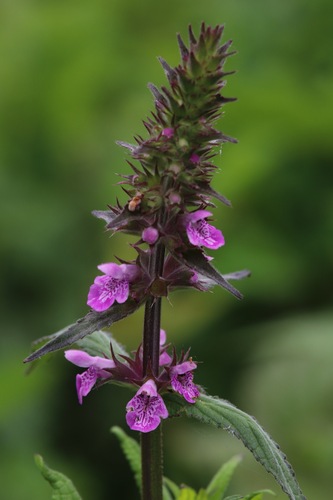
Marsh Woundwort
Stachys palustris
A champion of the wetlands, Marsh Woundwort brightens damp ditches and pond edges with its striking spikes of mottled purple flowers. This historic 'healer' of the garden is not only a visual delight but a vital sanctuary for your local bumblebees.
Quick Identification
Size
Height ranges from 30 to 100 cm (12 to 39 inches); individual flowers are roughly 12 to 15 mm (0.5 inches) long.
Colors
Pale pink to purple petals with distinctive darker purple and white mottled markings on the lower lip; stems are medium green to reddish-purple.
Key Features
- Square, hollow, and hairy stem typical of the mint family
- Lance-shaped, serrated leaves that lack stalks (sessile) or have very short ones
- Dense terminal spikes of pink-purple lipped flowers
- Spreading rhizomes that form thick, tuberous roots.
When You’ll See Them
Behavior
Marsh Woundwort is a resilient perennial herb that spreads primarily through its creeping underground rhizomes. Unlike many garden plants, it thrives in anaerobic, waterlogged soils where its roots form white, fleshy tubers. It is a social plant, often forming dense colonies in damp ditches or at the edges of ponds. While it doesn't 'move' in the animal sense, it exhibits phototropism, with its flower spikes reaching upward toward the strongest light source.
As a member of the Lamiaceae (mint) family, it has a complex relationship with local fauna. The flowers are specifically structured for long-tongued bees, such as bumblebees and honeybees, which must push deep into the corolla to reach the nectar. This interaction ensures the plant is effectively pollinated. To humans, the plant has a somewhat pungent, earthy aroma when the leaves are crushed, which historically served as a deterrent to some grazing herbivores.
Historically, the plant earned the name 'Woundwort' due to its use in folk medicine. The leaves were crushed and applied to cuts and abrasions to staunch bleeding and promote healing. While modern medicine has moved on, the plant remains a staple of naturalized 'wild' gardens because it provides a reliable late-summer nectar source when other flowers may be fading.
EverydayEarth exclusive
Camera Tips
Capturing Marsh Woundwort on a backyard or trail camera requires a different approach than filming wildlife. Because this plant grows in damp, often muddy areas, you should use a tripod with a low-profile base or a 'ground pod' to get the camera lens level with the flower spikes. Aim for a 45-degree upward angle to capture the intricate mottling inside the purple flowers and the hairy texture of the square stems. If your camera has a macro setting, this is the time to use it; the fine details of the lipped petals are what make this species truly stand out.
To get the best 'action' shots, set your camera to time-lapse mode or high-speed video. Marsh Woundwort is a magnet for bumblebees and hoverflies. By focusing on a single vibrant flower spike during the peak sun hours (10 AM to 2 PM), you are almost guaranteed to capture high-quality footage of pollinators interacting with the blooms. If your camera has a motion-trigger, set the sensitivity to high, as the slight vibration caused by a landing bee or a gentle breeze can trigger beautiful, short clips of the plant in its natural state.
Lighting is your best friend when photographing this species. Because the petals are somewhat translucent, try to position your camera so the sun is behind the plant (backlighting). This creates a 'halo' effect on the hairy stems and makes the pinkish-purple flowers glow. Conversely, early morning 'golden hour' light provides a soft, warm hue that emphasizes the plant's texture without the harsh shadows of midday. Avoid using a direct flash, which can wash out the subtle white-mottled patterns on the lower lip of the flower.
Since Marsh Woundwort grows in colonies, consider a wide-angle lens for one camera to capture the 'sea of purple' effect, while using a second camera for tight close-ups. If you are placing a camera specifically for this plant, look for the 'runners' or rhizomes in late spring; once you see the square stems emerging, you know exactly where the blooms will appear in mid-summer. Ensure your lens is clean of any water splashes, as its preferred damp habitat often results in condensation or mud splatter.
Similar Species
Species that look similar or are commonly confused with Marsh Woundwort.
Frequently Asked Questions
Record Marsh Woundwort at your habitat
Connect a camera to start building your own species record — AI identifies every visitor automatically.