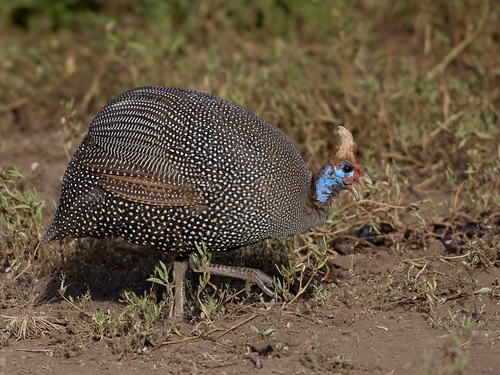
Helmeted Guineafowl
Numida meleagris
The Helmeted Guineafowl is nature's most stylish alarm system, decked out in charcoal-and-white polka dots and a striking blue face. Whether they are patrolling an African savanna or a suburban backyard, these social birds are world-class foragers and legendary pest controllers.
Quick Identification
Size
Length: 53–58 cm (21–23 in); Weight: 1.1–1.6 kg (2.4–3.5 lbs); Wingspan: 80–90 cm (31–35 in)
Colors
Slaty-gray to blackish plumage with uniform fine white spots; unfeathered blue and red face; yellowish or reddish bony casque on the head
Key Features
- Bony yellowish-brown 'helmet' or casque on top of the head
- Featherless blue and red facial skin with hanging wattles
- Large, rounded body with dark feathers and white polka-dots
- Loud, metallic, repetitive 'buck-wheat' call
When You’ll See Them
Sightings on EverydayEarth
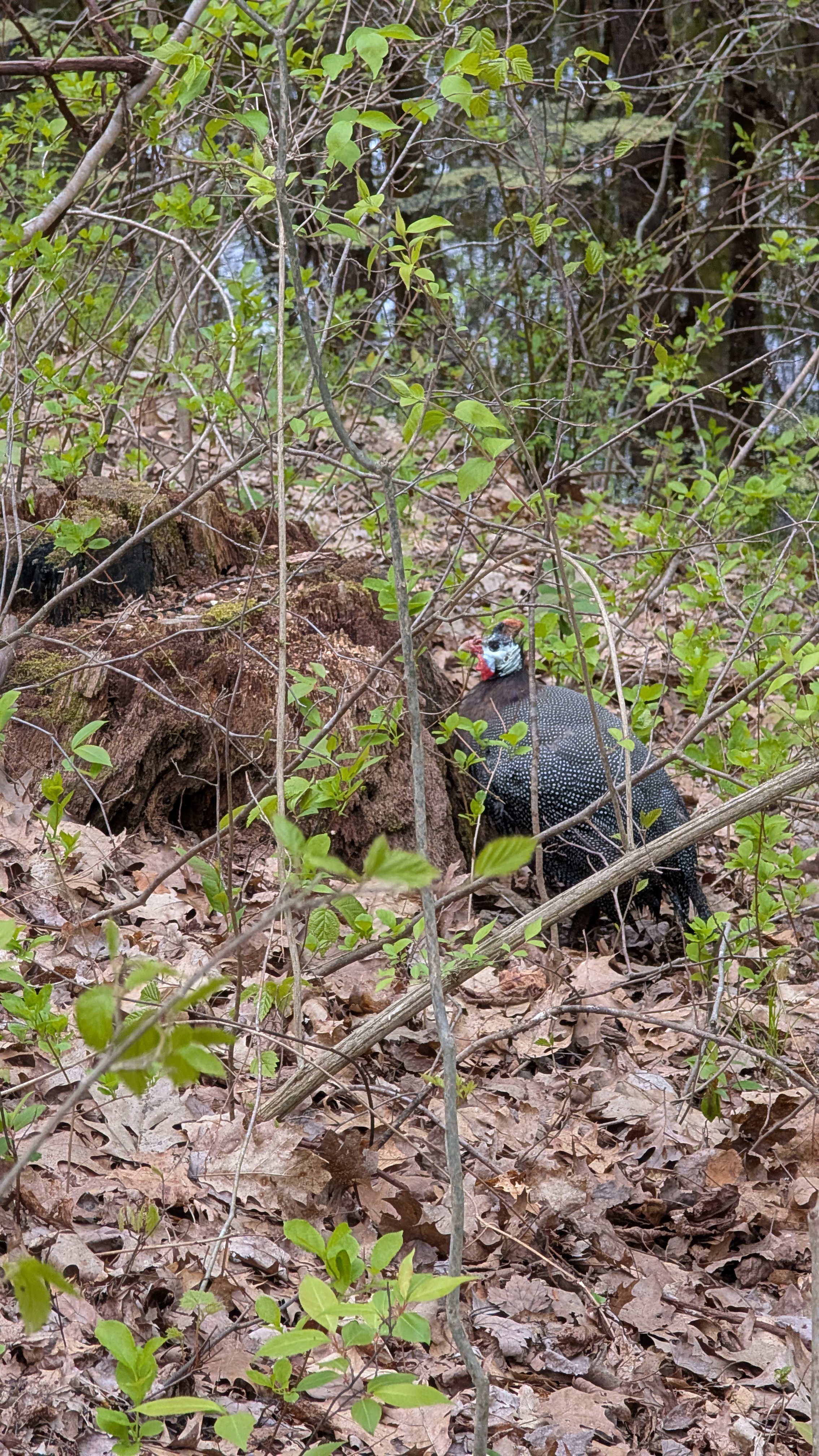
May 9, 2026
A Helmeted Guineafowl stands among the leaf litter and emerging spring greenery near a decayed tree stump. The bird's distinctive spangled feathers and colorful head are visible as it moves through the undergrowth.
Aug 1, 2026
A small flock of Helmeted Guineafowl is actively foraging in the dry grass at the center of the clearing. On the far left, an Impala is partially obscured as it grazes in the shade of a large bush.
Jul 31, 2026
Three Helmeted Guineafowl are seen foraging on a dry, grassy slope. They move in a small group, pecking at the ground for seeds or insects among the parched vegetation.
Jul 31, 2026
A small flock of Helmeted Guineafowl is foraging in the dry grass at the base of a large, gnarled tree. The birds are pecking at the ground, moving in a coordinated group while searching for seeds or insects.
Jul 31, 2026
A flock of Helmeted Guineafowl is foraging across a dry, grassy hillside. The birds move together as a group, pecking at the ground among low-lying shrubs and bushes.
Jul 29, 2026
A Knob-billed Duck wades through the shallow water of a waterhole, foraging along the edge. On the bank to the right, a Helmeted Guineafowl stands alert, monitoring the surroundings.
Geographic range
Where Does the Helmeted Guineafowl Live?
Native to the African continent, the Helmeted Guineafowl is found across almost the entire sub-Saharan region, from Senegal in the west to Ethiopia and down into South Africa. Because of their hardiness and utility in pest control, they have been successfully introduced to many other parts of the world, including the United States, Australia, Brazil, and the West Indies. In these non-native regions, they often exist as semi-wild populations on farms and in rural neighborhoods.
Basemap © OpenStreetMap contributors
Recorded on EverydayEarth
Behavior
Helmeted Guineafowl are highly social birds that spend the vast majority of their time on the ground. They live in large groups called 'confusions,' which can range from a few dozen to over a hundred birds outside of the breeding season. These flocks move in a loose formation, walking several miles a day to forage for food and water. While they are strong flyers, they prefer to escape danger by running, often reaching impressive speeds before taking to the air as a last resort.
As night falls, the flock retreats to the safety of high tree branches to roost, protecting themselves from nocturnal predators like leopards and caracals. They are famously vocal and serve as the 'alarm system' of the African savanna, emitting a harsh, ear-piercing shriek at the sight of a predator. In domestic settings, they are often kept for this very reason, as their ruckus will alert owners to the presence of hawks, snakes, or intruders.
EverydayEarth exclusive
Camera Tips
To capture the best footage of Helmeted Guineafowl, mount your camera low—approximately 12 to 18 inches off the ground. These are ground-dwelling birds, and a low angle provides a much more immersive look at their intricate spotting and unique facial wattles. Since they move in large groups, try to position the camera in a wide-open area of your yard or field to ensure you capture the whole flock rather than just one or two individuals walking past.
Guineafowl are easily lured by food. Scattering a trail of cracked corn, sunflower seeds, or a standard poultry 'scratch' mix in a clear patch of dirt will keep them in front of your camera for an extended period. They are also very attracted to water; a shallow ground-level birdbath or a simple saucer of water can be a major draw, especially during the hotter midday hours when they look for a place to drink and cool down.
Because these birds are constantly on the move—scratching the ground and nodding their heads—use a fast shutter speed or 'Burst Mode' on your camera to avoid motion blur. If your camera supports video, set it to record 15-20 second clips; the social interactions, dust bathing, and distinct vocalizations of a Guineafowl flock make for much more interesting content than a single still image. Avoid placing the camera in deep shade, as the contrast between their dark feathers and white spots looks best in bright, indirect morning light.
Similar Species
Species that look similar or are commonly confused with Helmeted Guineafowl.
Vulturine Guineafowl
Much larger and more colorful, with a cobalt blue chest and long neck feathers, but lacks the bony casque 'helmet' of the Helmeted Guineafowl.
Wild Turkey
Larger with a fan-shaped tail and brownish plumage; it lacks the Guineafowl's distinctive white polka-dot pattern and blue-skinned face.
Frequently Asked Questions
Record Helmeted Guineafowl at your habitat
Connect a camera to start building your own species record — AI identifies every visitor automatically.