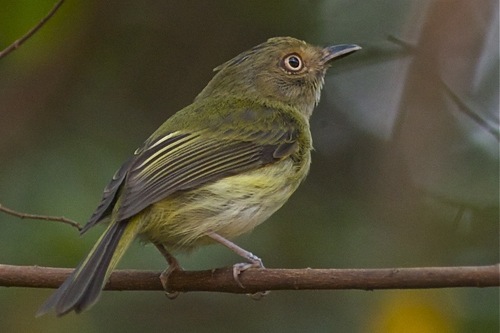
Helmeted Pygmy-Tyrant
Lophotriccus galeatus
A pint-sized marvel of the tropical canopy, the Helmeted Pygmy-Tyrant is famous for its spiky 'mohawk' crest and restless personality. This tiny flycatcher brings a dash of energetic charm to the forest edges of South America.
Quick Identification
Size
9–10 cm (3.5–4 in) in length; weighs approximately 6–7 g (0.21–0.25 oz)
Colors
Olive-green upperparts, dull gray throat and breast with olive streaks, pale yellow belly, and dark wings with yellowish edging.
Key Features
- Prominent spiky vertical crest or 'helmet'
- Large dark eyes on a relatively large head
- Short tail and rounded wings
- Constant wing-flicking behavior
When You’ll See Them
Geographic range
Where Does the Helmeted Pygmy-Tyrant Live?
This diminutive flycatcher is a native resident of northern South America, where it occupies a vast territory centered around the Amazon Basin and the Guiana Shield. Its presence is most documented across the northern half of Brazil, Venezuela, and the Guianas, extending westward into the lowland tropical zones of Colombia and Peru. Throughout this range, it is a non-migratory species, remaining in its tropical habitat year-round.
Basemap © OpenStreetMap contributors
Behavior
The Helmeted Pygmy-Tyrant is a restless and energetic tiny bird, known for its near-constant movement. Unlike many larger flycatchers that sit patiently for long periods, this species is frequently seen flitting between branches in the mid-canopy or forest edge. It has a distinctive habit of twitching its wings and tail nervously, a behavior that often helps birdwatchers locate it among dense foliage.
Socially, they are typically found alone or in pairs, though they may occasionally join mixed-species foraging flocks. They are highly vocal, often giving away their location with a dry, mechanical trill that sounds almost like an insect. While they are not particularly bold around humans, they are well-adapted to forest fragments and can become a regular fixture in backyards that maintain sufficient native cover.
EverydayEarth exclusive
Camera Tips
To capture the Helmeted Pygmy-Tyrant on a backyard or trail camera, height is the most critical factor. These birds rarely descend to the ground, so you should mount your camera at least 5 to 8 feet high, ideally on a tree trunk overlooking a break in the canopy or a flowering shrub. Aim the lens toward horizontal branches where the bird is likely to perch between hunting sorties.
Because these birds are insectivores, traditional birdseed will not attract them. Instead, focus on creating an 'insect magnet.' A small, solar-powered water dripper or a shallow birdbath placed on a pedestal can be very effective, as the sound of moving water attracts them both for drinking and for the small gnats that hover near moisture. Planting broad-leafed native plants will also provide the specific foraging environment they prefer.
Technical settings are vital because of the bird's small size and rapid movements. Set your camera to its highest sensitivity and use a fast trigger speed—0.2 seconds or better is ideal. Use a burst mode of 3-5 photos per trigger; these birds often flare their 'helmet' crest immediately after landing or just before calling, and a single shot is likely to miss this split-second display.
Lighting in tropical backyard settings can be tricky. Try to position your camera so it is back-lit by the morning sun to avoid blowing out the pale yellow of the bird's belly, or place it in an area with consistent dappled light. Since they are most active in the early morning, ensure your camera's batteries are fresh to handle the high volume of triggers during the dawn chorus.
Similar Species
Species that look similar or are commonly confused with Helmeted Pygmy-Tyrant.
Frequently Asked Questions
Record Helmeted Pygmy-Tyrant at your habitat
Connect a camera to start building your own species record — AI identifies every visitor automatically.