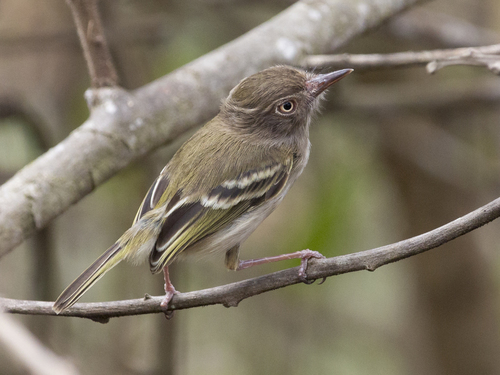
Pale-eyed Pygmy-Tyrant
Atalotriccus pilaris
Tiny, twitchy, and full of character, the Pale-eyed Pygmy-Tyrant is the garden's most energetic flycatcher. With its signature white eyes and constant wing-flicks, this miniature marvel is a delight for any backyard wildlife enthusiast.
Quick Identification
Size
Length: 9–10 cm (3.5–3.9 in); Weight: 5–7 g (0.18–0.25 oz)
Colors
Olive-brown to grayish-green upperparts, pale whitish-gray throat and breast, with a subtle yellow wash on the belly and flanks. Distinctive white to pale-cream iris.
Key Features
- Striking pale white or yellowish-white iris
- Frequent flicking of one or both wings
- Small, sharp bill with a slight hook
- Relatively long tail for its tiny body size
When You’ll See Them
Behavior
The Pale-eyed Pygmy-Tyrant is an exceptionally active and energetic little bird. Unlike many other members of the tyrant flycatcher family that sit still for long periods, this species is almost constantly in motion. It is well-known for its habit of nervously flicking its wings, sometimes one at a time, while perched. It tends to stay in the lower to middle levels of the vegetation, darting between branches with quick, jerky flights.
In social terms, they are usually found alone or in pairs. They are not particularly shy of humans and can often be found in suburban gardens or parks, provided there is enough dense shrubbery for them to feel secure. Their presence is often announced by their call—a dry, rhythmic series of 'chips' that sound somewhat mechanical, perfectly matching their busy personality.
EverydayEarth exclusive
Camera Tips
To successfully capture a Pale-eyed Pygmy-Tyrant on your camera, you must focus on the 'mid-story' of your backyard vegetation. These birds rarely visit the ground, so avoid low-mounted cameras. Instead, strap your camera to a tree or post about 4 to 6 feet high, aiming it at a horizontal branch that offers a clear view of a dense shrub or flowering bush. They love 'edge' environments, so placing the camera where a lawn meets a hedge is often a winning strategy.
Because these birds are incredibly small and fast, standard motion-trigger settings may be too slow. If your AI camera allows, increase the sensitivity to 'High' and set the capture mode to a short video clip (10-15 seconds) rather than a still photo. This will help you catch their signature wing-flicking behavior, which is often too fast for a single frame to capture clearly. Ensure the camera is positioned with the sun at its back to properly illuminate the bird's pale iris, which can otherwise look dark in deep shade.
While they won't come to a traditional seed feeder, you can attract them to your camera's field of view by providing a water source. A birdbath with a 'dripper' or a small solar-powered fountain is a magnet for pygmy-tyrants. The sound of moving water draws them in, and they will often use a nearby branch as a staging area to check for predators before taking a dip, giving your camera the perfect opportunity to record them.
Lastly, pay attention to the seasons. During nesting periods, they are frequently seen carrying fine nesting materials like spider silk and plant down. If you notice a pair frequenting a specific area of your yard, look for a small, pouch-like nest hanging from a branch. Placing a camera near (but not too close to) these sites can provide amazing footage of their nesting habits, but always prioritize the bird's safety and avoid disturbing the nest site directly.
Similar Species
Species that look similar or are commonly confused with Pale-eyed Pygmy-Tyrant.
Frequently Asked Questions
Record Pale-eyed Pygmy-Tyrant at your habitat
Connect a camera to start building your own species record — AI identifies every visitor automatically.