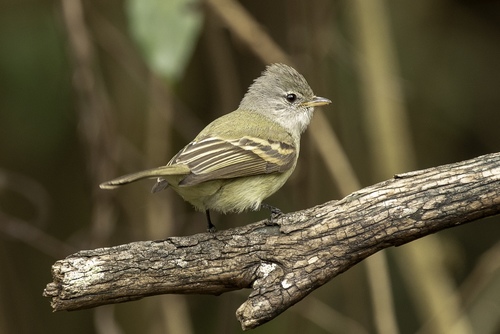
Southern Beardless-Tyrannulet
Camptostoma obsoletum
The Southern Beardless-Tyrannulet is a tiny dynamo of the canopy, known for its expressive crest and restless energy. A master of the treetops, this vocal little flycatcher is a common but delightful visitor to gardens across Central and South America.
Quick Identification
Size
Length: 9.5–10.5 cm (3.7–4.1 in); Weight: 7.5–9 g (0.26–0.32 oz)
Colors
Dull olive-grey upperparts with a greyish-brown crown; pale yellow to whitish underparts; two thin, pale yellowish wing bars.
Key Features
- Bushy, often-raised crest giving the head a peaked appearance
- Small, dark bill notably lacking rictal bristles (beardless)
- Restless, warbler-like foraging movement
- Two distinct but narrow pale wing bars
When You’ll See Them
Behavior
The Southern Beardless-Tyrannulet is a tiny, energetic bird that behaves more like a kinglet or a warbler than a traditional "sit-and-wait" flycatcher. It is constantly in motion, flitting through the outer foliage of trees and shrubs to glean insects. One of its most endearing qualities is its expressive crown; it frequently raises its head feathers into a messy, pointed crest, especially when curious or territorial.
These birds are usually found singly or in pairs, though they frequently join mixed-species foraging flocks to move through the canopy. They are highly vocal, often giving away their location with a series of thin, descending whistles. Despite their diminutive size, they are quite bold and have adapted well to human-altered landscapes, making them a common sight in suburban gardens and parks throughout their range.
EverydayEarth exclusive
Camera Tips
To capture high-quality footage of the Southern Beardless-Tyrannulet, camera placement is critical. These birds spend most of their time in the mid-to-high canopy, rarely venturing to the ground. Position your AI camera on a sturdy limb or a mounting pole at least 6 to 8 feet high. Focus the lens on the "edges" of your yard—where a hedge meets a clear space or near the outer branches of a fruiting tree—as these are their favorite corridors for movement.
While they won't visit seed feeders, they are highly attracted to water. A birdbath with a solar-powered dripper or a small fountain is the best lure for this species. Because they are so small and move so quickly, place the camera within 3 to 5 feet of the water source. Use a high-speed trigger setting or a high-frame-rate video mode to ensure you catch their rapid-fire bathing rituals without motion blur.
Lighting is your best friend when trying to distinguish this bird from other similar-looking flycatchers. Try to position your camera so it faces away from the morning sun (North or South) to avoid silhouetting. The early morning light will highlight the subtle yellow in their bellies and the texture of their crest. If your backyard has native berry-producing shrubs like Lantana, aim a secondary camera there, as they will often pause for several seconds to forage, providing a perfect window for the AI to identify the species.
Similar Species
Species that look similar or are commonly confused with Southern Beardless-Tyrannulet.
Northern Beardless-Tyrannulet
Nearly identical visually but has a different song and is found from the Southwestern US through Mexico.
Yellow-bellied Elaenia
Significantly larger with a more prominent crest and a heavier, broader bill.
Mouse-colored Tyrannulet
Lacks the yellowish tint on the belly and has much more obscure wing bars.
Frequently Asked Questions
Record Southern Beardless-Tyrannulet at your habitat
Connect a camera to start building your own species record — AI identifies every visitor automatically.